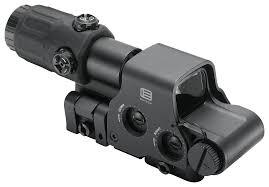
In tactical operations, hunting, and competitive shooting, speed and precision are critical. Traditional iron sights require precise alignment of front and rear posts, which slows down aiming.
Basic red dot optics improve speed but often struggle with parallax issues, limited field of view, and reduced clarity in extreme conditions. For manufacturers and OEM suppliers, delivering fast, reliable aiming solutions is a competitive requirement.
What Is a Holographic Sight and How It Works
A Holographic sight is an advanced optical aiming device that uses laser-generated holography to project a reticle onto the viewing window. Unlike traditional red dots, the reticle image is embedded within a holographic film inside the optic.
How it works:
-
A laser diode illuminates a holographic grating
-
The hologram reconstructs the reticle image
-
The shooter sees a reticle that appears at a set distance
-
The reticle remains aligned with the target, even if the eye position shifts
High-performance Holographic sight systems provide accurate aiming with minimal parallax and wide viewing angles.
Limitations of Traditional Aiming Systems
1. Iron Sights
-
Require strict front and rear alignment
-
Slow in dynamic situations
-
Poor performance in low light
2. Basic Red Dot Sights
-
Limited field of view
-
Reticle distortion under certain angles
-
Parallax shift at longer distances
3. Mechanical Scope Systems
-
Heavier weight
-
Slower close-range engagement
-
Narrower eye box
These issues reduce reaction speed and overall shooting efficiency.
How Holographic Sight Technology Solves These Problems
Holographic technology improves both speed and accuracy.
Key benefits include:
-
Wide rectangular viewing window
-
Reduced parallax error
-
Fast reticle acquisition
-
Consistent reticle clarity in various lighting conditions
Because the reticle is reconstructed holographically, it remains aligned with the target even if the shooter’s head position changes slightly.
Advanced Holographic sight designs also maintain visibility if the front window becomes partially obstructed, increasing reliability in tactical scenarios.
Key Features That Matter to Manufacturers and Engineers
-
Laser-based holographic reticle system
-
Wide field of view window design
-
Shock-resistant housing
-
Waterproof and dustproof sealing
-
Multiple brightness levels for day and night use
-
Compatibility with magnifiers
These features enhance durability and expand application possibilities.
Holographic Sight vs Red Dot vs Magnified Scope
| Feature | Holographic Sight | Red Dot Sight | Magnified Scope |
|---|---|---|---|
| Target Acquisition Speed | Very Fast | Fast | Moderate |
| Field of View | Wide | Moderate | Narrow |
| Parallax Error | Minimal | Moderate | Low |
| Close-Range Performance | Excellent | Good | Limited |
| Weight | Moderate | Light | Heavy |
| Tactical Reliability | High | Moderate | High |
For close- to mid-range engagements, holographic sights offer superior balance between speed and accuracy.
Real Applications in Tactical and Sporting Fields
Holographic sights are widely used in:
-
Military rifles
-
Law enforcement firearms
-
Competitive shooting platforms
-
Hunting rifles
-
Tactical training systems
In dynamic environments, rapid target acquisition can directly impact performance and safety.
Why Manufacturers Prefer Holographic Sights
Manufacturers prefer holographic sight systems because they:
-
Improve user performance and satisfaction
-
Increase product differentiation in competitive markets
-
Offer high durability under recoil and shock
-
Support modular weapon platforms
-
Align with professional tactical standards
The technology supports both premium and specialized firearm markets.
How to Choose the Right Holographic Sight
When selecting a holographic sight, evaluate:
Reticle Design
Choose between single dot, circle-dot, or custom reticles.
Durability Standards
Ensure shock resistance for high-caliber recoil.
Power Efficiency
Check battery life and automatic shut-off features.
Environmental Protection
Confirm waterproof and fog-resistant construction.
Mount Compatibility
Verify compatibility with standard rail systems.
Choosing the correct configuration ensures performance reliability and integration efficiency.
Conclusion
Modern shooting environments demand fast reaction, high precision, and durable equipment. Traditional iron sights and basic red dot systems cannot fully meet these requirements in dynamic conditions.
Holographic sight technology offers wide field of view, minimal parallax error, and reliable reticle clarity. Its advanced optical design enhances speed and accuracy while maintaining durability under heavy recoil.
For firearm manufacturers and tactical equipment suppliers, integrating high-quality holographic sight systems strengthens product performance and competitive positioning in professional and sporting markets.

 English
 French
 Spanish
 Portuguese
 Deutsch
 Turkish
 Dutch
Dutch
 Italiano
 Russian
 Romaian
 Portuguese (Brazil)
 Greek
Greek