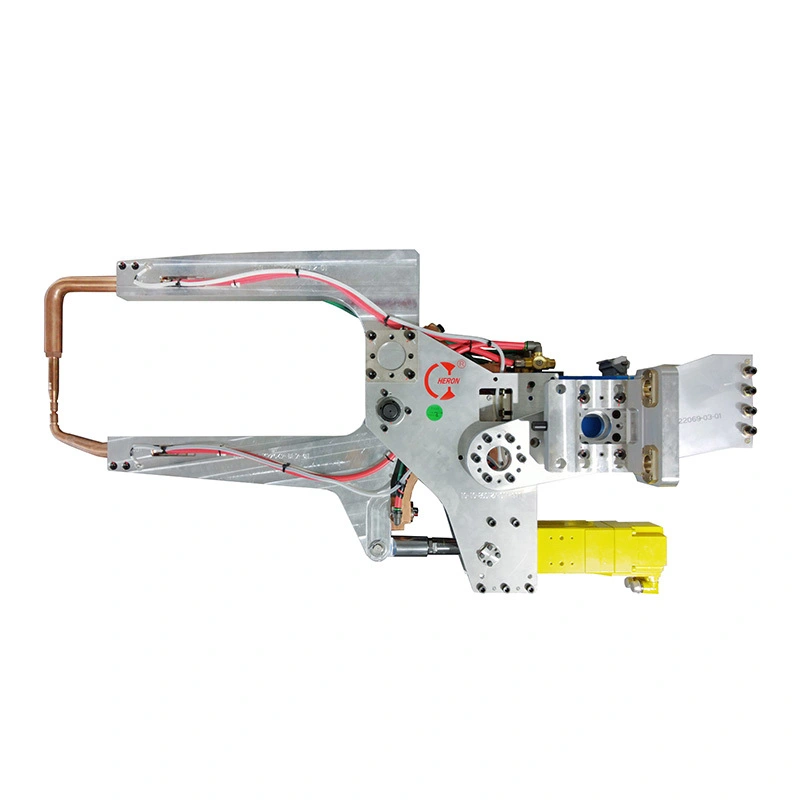
In today’s competitive manufacturing landscape, joining aluminum efficiently, reliably, and cost-effectively is a critical challenge for OEMs, production engineers, and automation integrators. Aluminum’s high thermal conductivity and oxide layer make traditional welding methods less effective, requiring specialized solutions. This is where an aluminum spot welder becomes an essential asset for modern factories.
Heron Welder, a global leader in industrial welding solutions, offers advanced spot welding systems engineered for high-performance aluminum joining, tailored to diverse industrial applications.
What Is an Aluminum Spot Welder?
An aluminum spot welder is a type of resistance welding machine designed to join aluminum sheets or components by applying pressure and passing a controlled electrical current through the metal. Unlike steel, aluminum’s lower resistivity and thermal conductivity require precise energy control, specialized electrode materials, and optimized welding cycles.
Key components include:
-
Electrodes: Copper or copper alloy tips designed to handle high currents without excessive wear.
-
Power Supply: MFDC (Medium-Frequency Direct Current) or capacitor discharge systems for precise energy delivery.
-
Controller: Advanced digital controllers for adjusting current, weld time, and force to suit aluminum’s properties.
Heron’s aluminum spot welders integrate these elements into a robust system suitable for manual, semi-automatic, or fully automated production lines.
Principles of Aluminum Spot Welding
The aluminum spot welding process relies on resistance heating:
-
Clamping: Electrodes press the aluminum sheets together with precise force.
-
Current Flow: A high-amperage electrical pulse passes through the metal at the contact point.
-
Heat Generation: Electrical resistance at the interface generates heat, melting the material locally.
-
Cooling and Solidification: After the current stops, the molten aluminum solidifies, forming a strong metallurgical bond.
Because aluminum’s conductivity is higher than steel, higher current and shorter weld times are required. Modern systems, like those from Heron, use MFDC or advanced capacitor discharge technology to ensure consistent weld quality with minimal spatter or distortion.
Applications of Aluminum Spot Welders
Aluminum spot welders are widely used across industries where lightweight construction, strength, and reliability are critical. Key applications include:
1. Automotive and EV Manufacturing
Aluminum is increasingly used in car body panels, EV battery enclosures, and chassis components to reduce weight and improve energy efficiency. Heron spot welders deliver repeatable, high-quality welds essential for safety and structural integrity.
2. Aerospace and Aviation
Aircraft components require lightweight, high-strength joints. Precision aluminum spot welding ensures durable connections without compromising material properties.
3. Electronics and Electrical Enclosures
Battery packs, aluminum casings, and heat sinks benefit from controlled spot welding to maintain electrical and thermal performance.
4. Industrial Equipment and Appliances
From HVAC panels to industrial machinery, aluminum spot welding offers fast production cycles and consistent quality, supporting mass production without rework.
Comparing Aluminum Spot Welding to Other Joining Methods
| Feature | Aluminum Spot Welding | MIG/TIG Welding | Adhesive Bonding | Mechanical Fastening |
|---|---|---|---|---|
| Speed | Very fast, suitable for automation | Slower, operator-dependent | Moderate, curing time needed | Moderate |
| Strength | High, metallurgical bond | High, but risk of distortion | Medium | Variable |
| Automation | Easily automated | Difficult to fully automate | Possible, but setup-intensive | Easy |
| Material Thickness | Thin to medium sheets | Variable | Thin | Thin to thick |
| Heat Input | Localized, controlled | High | Minimal | None |
Heron’s aluminum spot welders outperform alternative methods in high-volume production, offering precise control, repeatable weld quality, and integration with automated production lines.
Best Practices for Aluminum Spot Welding
To achieve optimal results, manufacturers should consider the following:
-
Electrode Maintenance: Regularly dress electrodes to maintain proper shape and surface conductivity.
-
Current Control: Use MFDC or capacitor discharge systems to manage peak current and avoid overheating.
-
Weld Scheduling: Optimize weld time, force, and cooling intervals for specific aluminum alloys and thicknesses.
-
Material Preparation: Remove oxide layers or apply coatings to improve electrical contact.
-
Monitoring and Quality Assurance: Use real-time weld monitoring systems to ensure consistent performance and reduce scrap.
Heron Welder’s systems come equipped with advanced controllers and monitoring software to guide engineers through these best practices seamlessly.
Why Choose Heron for Aluminum Spot Welding?
Heron Welder has over two decades of experience providing industrial welding solutions to OEMs, automation integrators, and global manufacturers. Our aluminum spot welders are:
-
Customizable: From manual bench units to fully automated robotic lines.
-
Reliable: Engineered for continuous industrial use with minimal downtime.
-
Precision-Controlled: MFDC and capacitor discharge technology ensure consistent weld quality.
-
Globally Supported: Comprehensive service and consultation for production line optimization.
Whether you’re scaling EV battery production or automating sheet metal assembly, Heron provides end-to-end solutions, from equipment supply to system integration.
FAQs About Aluminum Spot Welding
Q1: Can aluminum spot welding replace traditional MIG/TIG methods?
A1: For sheet metal applications, spot welding is faster, more repeatable, and better suited for automation. MIG/TIG may still be needed for thick sections or complex geometries.
Q2: What thicknesses can aluminum spot welders handle?
A2: Heron aluminum spot welders are optimized for thin to medium sheets (0.5–5 mm) but can be adapted for specialized applications.
Q3: How is electrode wear managed?
A3: Electrodes are made from high-conductivity copper alloys. Regular dressing and monitoring maintain performance and consistent weld quality.
Q4: Can these welders integrate into robotic lines?
A4: Yes. Heron offers fully automated spot welding cells compatible with industrial robots and PLC systems for high-volume production.
Q5: Is real-time weld quality monitoring available?
A5: Absolutely. Heron systems feature digital controllers and optional weld monitoring to ensure repeatable, defect-free joints.
Conclusion: Enhance Production with Heron Aluminum Spot Welders
Efficient, precise, and repeatable aluminum joining is no longer a challenge with modern aluminum spot welders. Heron Welder provides advanced, customizable solutions for automotive, aerospace, electronics, and industrial applications, empowering engineers and manufacturers to increase productivity while maintaining quality and reliability.
Ready to optimize your aluminum welding process? Contact Heron today to request a quote or consult with our experts for tailored welding and automation solutions.

 Arabic
 French
 Spanish
 Portuguese
 Deutsch
 Turkish
 Dutch
Dutch
 Italiano
 Russian
 Romaian
 Portuguese (Brazil)
 Greek
Greek