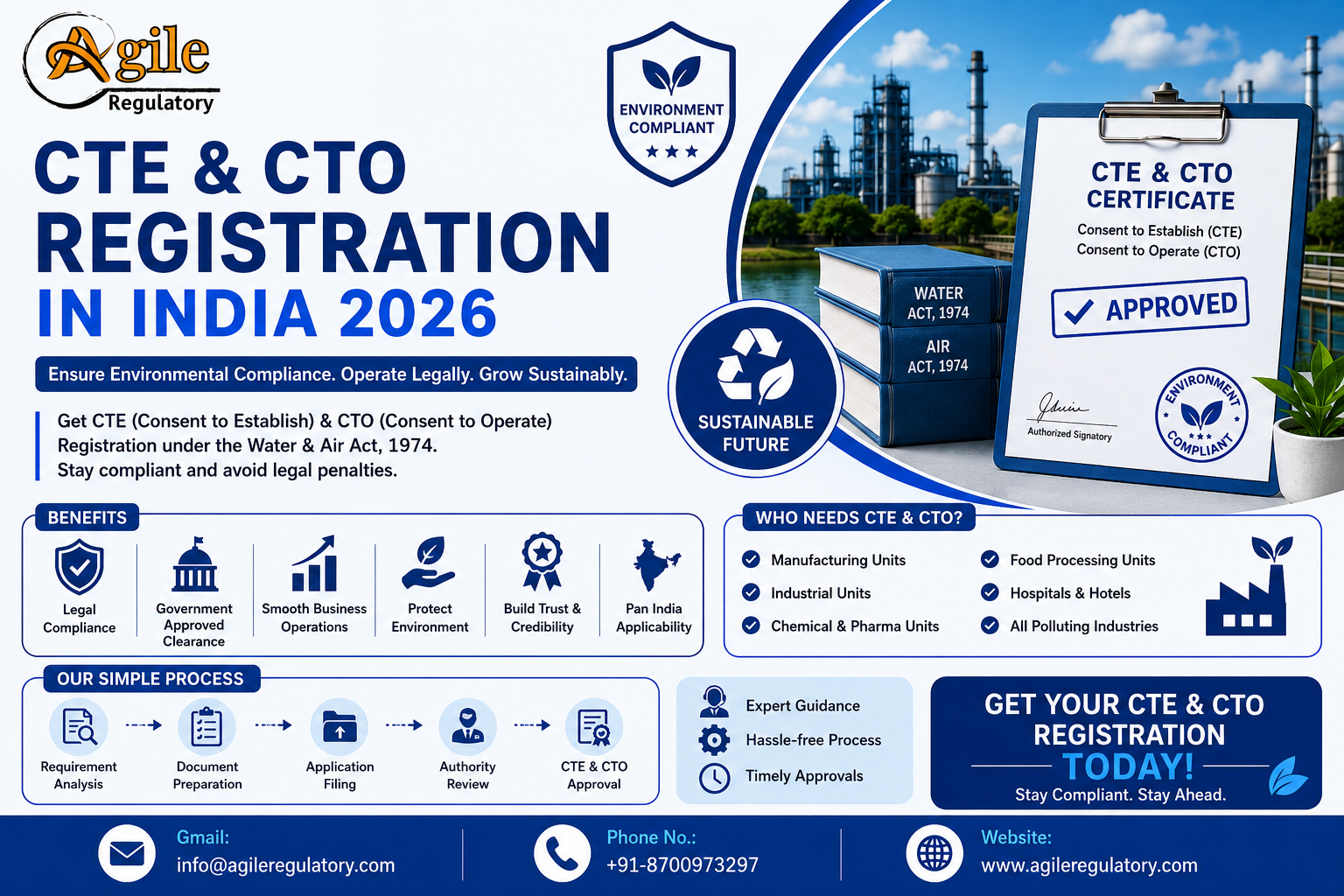
Before setting up an industrial unit, manufacturing facility, healthcare establishment, or certain commercial projects in India, businesses are required to obtain environmental approval from the respective State Pollution Control Board. This approval, known as Consent to Establish, ensures that the proposed project complies with environmental laws and pollution control standards before construction or installation begins. Obtaining the consent at the planning stage helps businesses avoid legal issues, project delays, and regulatory penalties. This guide explains eligibility, required documents, the application process, benefits, and compliance requirements.
Consent to Establish
What is Consent to Establish?
Consent to Establish (CTE) is a statutory approval granted by the concerned State Pollution Control Board under the Water (Prevention and Control of Pollution) Act, 1974 and the Air (Prevention and Control of Pollution) Act, 1981. It allows eligible industries and establishments to begin construction, installation, or expansion after ensuring that the proposed project complies with environmental regulations.
Obtaining Consent to Establish is mandatory for many industries before commencing construction or installing machinery.
The consent is generally obtained before applying for operational approvals.
Why is Consent to Establish Important?
Obtaining CTE offers several important benefits.
Legal Compliance
It ensures compliance with applicable environmental laws before project implementation.
Environmental Protection
The approval helps minimize the environmental impact of industrial activities.
Smooth Project Development
Businesses can proceed with construction after obtaining regulatory clearance.
Reduced Compliance Risk
Early approval helps prevent legal disputes and project delays.
Industries operating in Uttar Pradesh obtain this approval from the UP Pollution Control Board in accordance with the applicable environmental regulations.
Who Should Apply?
Consent to Establish is generally required for:
- Manufacturing Units
- Food Processing Industries
- Chemical Industries
- Pharmaceutical Units
- Hospitals
- Hotels and Resorts
- Warehouses
- Plastic Processing Units
- Engineering Industries
- Large Commercial Projects
The requirement depends on the category of industry and its pollution potential.
Documents Required
Applicants generally require:
Business Documents
- Company Registration Certificate
- PAN Card
- GST Registration Certificate
- Factory Licence (where applicable)
- Land Ownership or Lease Documents
Technical Documents
- Project Report
- Manufacturing Process Flow Chart
- Site Layout Plan
- Machinery Details
- Water Consumption Details
- Air Emission Details
- Waste Management Plan
Supporting Documents
- Identity Proof
- Address Proof
- Authorized Signatory Details
Preparing complete documentation significantly improves approval timelines.
Step-by-Step Application Process
Step 1 Project Assessment
Determine whether the proposed industry falls under the applicable environmental consent requirements.
Step 2 Prepare Documentation
Collect all prescribed technical, environmental, and business documents.
Step 3 Submit the Application
Complete the online application through the respective State Pollution Control Board portal along with the required documents and prescribed fee.
Depending on the project category, applicants may also require a Pollution NOC before proceeding with construction or installation.
Step 4 Technical Evaluation
The Pollution Control Board examines the project proposal, environmental safeguards, and supporting documents.
Step 5 Site Inspection
Where required, officials may inspect the proposed site before granting approval.
Step 6 Grant of Consent
After successful verification, the Consent to Establish is issued for the approved project.
Pollution Control Approvals
Environmental compliance often involves multiple approvals depending on the project stage.
Many industries also require a Pollution License to comply with state environmental regulations governing emissions, effluent discharge, and waste management.
Businesses should verify all applicable approvals before commencing operations.
Pollution Control Board Licence
Environmental approvals are issued based on the category of the industry and pollution potential.
A valid Pollution Control Board License demonstrates that the project complies with the prescribed environmental standards and regulatory requirements.
Maintaining compliance helps avoid legal action.
Consent to Operate
After completing construction and installing the required pollution control systems, industries generally need to obtain Consent to Operate before commencing commercial production.
This approval confirms that the unit complies with environmental norms during actual operations.
Role of the Pollution Control Board
The Pollution Control Board is responsible for monitoring industrial activities, issuing environmental consents, conducting inspections, and enforcing pollution control laws.
Its primary objective is to protect public health and the environment while supporting sustainable industrial development.
Benefits of Consent to Establish
Obtaining the required approval offers several long-term advantages.
Regulatory Compliance
Businesses comply with applicable environmental legislation.
Faster Project Approval
Early environmental clearance reduces implementation delays.
Better Business Reputation
Compliance demonstrates environmental responsibility.
Sustainable Operations
Proper planning helps minimize pollution and environmental risks.
Common Mistakes to Avoid
Incomplete Documentation
Missing environmental or technical documents frequently delay approvals.
Incorrect Project Details
Ensure that all submitted information matches the actual project specifications.
Delayed Application
Apply before beginning construction or installing machinery.
Ignoring Environmental Requirements
Failure to install pollution control measures may affect future approvals.
Why Choose Agile Regulatory?
Agile Regulatory provides professional consultancy for environmental approvals across India. Our experienced compliance experts assist industries, manufacturers, hospitals, commercial establishments, and infrastructure projects with documentation, application filing, regulatory coordination, and complete environmental compliance support.
Apart from Consent to Establish, Agile Regulatory also offers consultancy for:
- Consent to Operate (CTO)
- Hazardous Waste Authorization
- EPR Registration
Our experts ensure accurate documentation and hassle-free regulatory approvals, helping businesses achieve environmental compliance efficiently.
Conclusion
Obtaining Consent to Establish is an essential step before setting up many industrial and commercial projects in India. The approval ensures compliance with environmental regulations, supports sustainable development, and minimizes legal risks. By preparing complete documentation and following the prescribed application procedure, businesses can avoid unnecessary delays and secure timely environmental clearance. With expert guidance from Agile Regulatory, applicants can complete the approval process smoothly and confidently move forward with their projects.
FAQs
1. What is Consent to Establish?
Consent to Establish is an environmental approval issued by the State Pollution Control Board before the construction or installation of eligible industrial and commercial projects.
2. Who needs Consent to Establish?
Manufacturing units, hospitals, food industries, pharmaceutical companies, hotels, engineering industries, and several other businesses generally require this approval.
3. Is Consent to Establish mandatory before construction?
Yes. Eligible industries are generally required to obtain Consent to Establish before beginning construction or installing machinery.
4. What documents are generally required?
Applicants usually require company registration documents, project report, site layout, manufacturing process details, environmental information, land documents, and supporting business records.
5. How can Agile Regulatory help?
Agile Regulatory provides complete assistance with Consent to Establish applications, documentation, online filing, environmental compliance, and end-to-end regulatory support across India.

 English
 Arabic
 French
 Spanish
 Portuguese
 Turkish
 Dutch
Dutch
 Italiano
 Russian
 Romaian
 Portuguese (Brazil)
 Greek
Greek