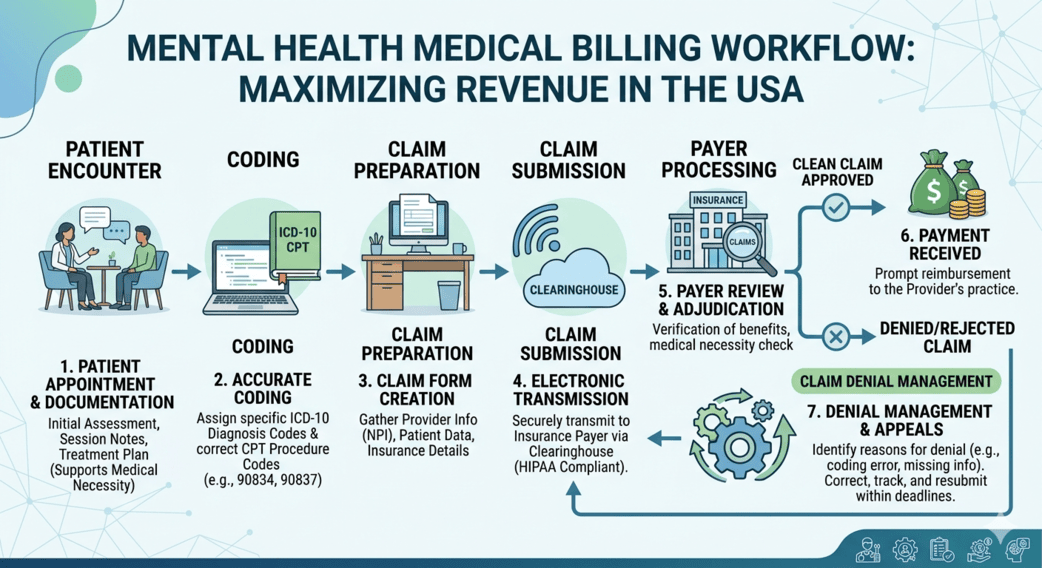
Running a mental health practice takes more than providing quality care. Therapists, psychologists, psychiatrists, and behavioral health clinics also spend a significant amount of time dealing with insurance claims, documentation, payment follow-ups, and changing payer rules. These administrative tasks can quickly reduce the time available for patient care.
This is one of the main reasons why many providers are choosing outsourcing mental health billing. Instead of handling complex billing tasks in-house, practices partner with experienced professionals who manage the billing process accurately and efficiently.
Whether you are an independent therapist or part of a growing behavioral health organization, understanding how outsourced billing works can help you make better financial and operational decisions.
Why Mental Health Billing Is More Complex Than Many Medical Specialties
Mental health billing has unique requirements that make it different from general healthcare billing. Insurance companies often have different policies for behavioral health services, and documentation standards continue to evolve.
Common challenges include:
- Verifying patient insurance benefits
- Managing prior authorizations when required
- Using accurate diagnosis and procedure codes
- Submitting clean claims on time
- Handling claim denials and appeals
- Following payer-specific documentation requirements
- Tracking patient balances and insurance payments
Even small billing errors can delay reimbursement or result in denied claims. Over time, these issues can impact a practice's cash flow.
What Does Outsourcing Mental Health Billing Mean?
Outsourcing mental health billing means hiring a specialized billing company to handle some or all of your billing responsibilities.
Depending on the agreement, an outsourced team may manage:
- Insurance eligibility verification
- Charge entry
- Claim submission
- Payment posting
- Denial management
- Accounts receivable follow-up
- Patient billing support
- Financial reporting
The goal is to allow mental health providers to focus on patient care while experienced billing professionals manage the financial side of the practice.
Signs Your Practice May Benefit from Outsourcing
Many practices wait until billing problems become overwhelming before seeking outside help. However, recognizing the warning signs early can prevent revenue loss.
You may benefit from outsourcing if you notice:
Frequent Claim Denials
Repeated denials often indicate problems with coding, documentation, or payer requirements.
Slow Payments
Long reimbursement cycles create cash flow challenges and make financial planning difficult.
Staff Spending Too Much Time on Billing
When administrative staff spend most of their day resolving billing issues instead of supporting patients, efficiency decreases.
Difficulty Keeping Up with Insurance Changes
Insurance regulations and coding guidelines change regularly. Staying current requires continuous learning.
Growth Creating More Administrative Work
As patient volume increases, billing becomes more complex. Outsourcing can help practices grow without immediately expanding internal staff.
Key Benefits of Outsourcing Mental Health Billing
More Time for Patient Care
Mental health professionals enter the field to help people, not spend hours correcting rejected claims.
By outsourcing billing, providers can dedicate more time to therapy sessions, treatment planning, and patient communication.
Improved Claim Accuracy
Experienced billing specialists understand payer guidelines and billing requirements. This helps reduce claim errors and increases first-pass acceptance rates.
Accurate billing often leads to faster reimbursements.
Better Revenue Cycle Management
An organized billing process improves collections from both insurance companies and patients.
Professional revenue cycle management includes monitoring every stage of the payment process, from scheduling to final reimbursement.
This visibility helps practices identify financial trends and resolve issues before they become major problems.
Lower Administrative Burden
Managing billing internally often requires:
- Hiring additional employees
- Staff training
- Software updates
- Compliance monitoring
- Ongoing education
Outsourcing reduces many of these operational responsibilities.
Easier Compliance
Healthcare regulations continue to change. Professional billing teams stay informed about payer policies, documentation standards, and coding updates to help practices maintain compliance.
The Importance of Specialized Coding
Accurate coding is one of the most important parts of successful mental health billing.
Behavioral health providers must correctly report:
- Psychiatric evaluations
- Individual therapy
- Family therapy
- Group therapy
- Medication management
- Telehealth sessions
Professional medical coding services help ensure that diagnosis codes, CPT codes, and documentation work together correctly, reducing the risk of rejected claims.
How Credentialing Supports Successful Billing
Billing cannot begin if providers are not properly enrolled with insurance companies.
This is where credentialing becomes essential.
Proper credentialing helps providers:
- Join insurance networks
- Receive timely reimbursements
- Avoid unnecessary claim rejections
- Expand access for insured patients
Many billing companies also assist with credentialing to simplify the onboarding process for new providers.
Questions to Ask Before Choosing a Billing Partner
Not every billing company has experience with behavioral health.
Before making a decision, ask questions such as:
- Do they specialize in mental health billing?
- How do they handle denied claims?
- What reports will they provide?
- How do they protect patient information?
- Which practice management software do they support?
- How quickly do they respond to billing questions?
- What experience do they have with behavioral health insurance plans?
Choosing the right partner is about more than price. Industry knowledge and communication are equally important.
Common Mistakes Practices Should Avoid
Even with experienced clinical teams, billing mistakes can reduce revenue.
Some common issues include:
- Missing claim deadlines
- Incorrect patient information
- Incomplete documentation
- Wrong diagnosis or procedure codes
- Failure to verify insurance benefits
- Ignoring unpaid claims for extended periods
Working with professionals who specialize in medical billing services can help reduce these avoidable errors and create a more consistent billing process.
Is Outsourcing the Right Choice for Small Practices?
Many independent therapists assume outsourcing only benefits large organizations.
In reality, smaller practices often gain the most value because they usually have limited administrative resources.
Instead of hiring multiple in-house billing employees, small practices can access experienced billing professionals without significantly increasing operational complexity.
This allows providers to focus on delivering quality mental healthcare while maintaining healthier financial performance.
Choosing the Right Partner
Finding a billing partner requires careful evaluation. Look for a company that understands behavioral health workflows, communicates clearly, provides transparent reporting, and stays current with industry regulations.
For example, 247 Medical Billing Services supports healthcare organizations with comprehensive billing solutions, including medical billing services, medical coding services, credentialing, and revenue cycle management. Working with an experienced team can help practices improve operational efficiency while allowing providers to dedicate more attention to patient care rather than administrative tasks.
Final Thoughts
Mental health practices face increasing administrative demands alongside growing patient needs. Billing mistakes, delayed reimbursements, and changing insurance requirements can create unnecessary stress for providers and staff.
Outsourcing mental health billing offers a practical solution by improving billing accuracy, reducing administrative workload, supporting compliance, and strengthening financial performance. When practices partner with experienced billing professionals, they can spend less time managing paperwork and more time helping patients achieve better mental health outcomes.
Frequently Asked Questions
1. What is outsourcing mental health billing?
It is the process of hiring an external billing company to manage insurance claims, payment posting, denial management, and other billing tasks for mental health providers.
2. Is outsourcing mental health billing cost-effective?
Yes. Many practices reduce administrative expenses, improve claim accuracy, and receive faster reimbursements, making outsourcing a cost-effective option over time.
3. Can small therapy practices outsource billing?
Absolutely. Solo practitioners and small behavioral health clinics often benefit from outsourcing because it reduces administrative workload without requiring additional in-house staff.
4. Does outsourced billing improve claim approval rates?
Experienced billing professionals follow payer guidelines closely, which helps reduce claim errors and increases the likelihood of first-pass claim acceptance.
5. How does credentialing affect mental health billing?
Credentialing allows providers to participate in insurance networks and receive reimbursements. Without proper credentialing, claims may be delayed or denied.
6. Why are medical coding services important in mental health billing?
Accurate coding ensures claims reflect the services provided and meet payer requirements, helping reduce denials and payment delays.
7. What should I look for in a mental health billing company?
Choose a company with behavioral health experience, transparent reporting, strong communication, compliance knowledge, and expertise in medical billing services, medical coding services, credentialing, and revenue cycle management.

 English
 French
 Spanish
 Portuguese
 Deutsch
 Turkish
 Dutch
Dutch
 Italiano
 Russian
 Romaian
 Portuguese (Brazil)
 Greek
Greek