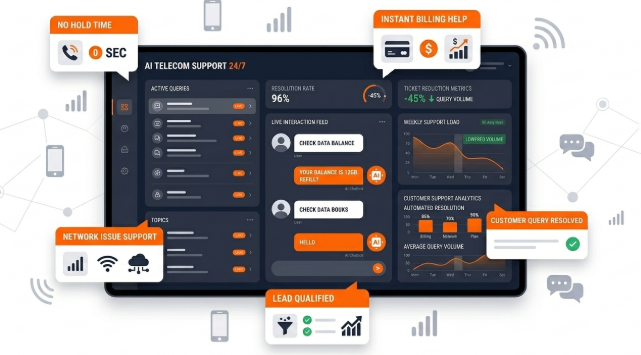
An AI customer service agent doesn't work equally well for every business. It thrives in some industries and barely makes a dent in others.
The pattern is clear: industries with high volumes of repetitive questions and routine support requests see the biggest benefit. Industries with mostly complex, case-by-case decision-making see less impact.
Where should you look first if you're evaluating whether this tool makes sense for your industry?
E-Commerce: The Obvious Win
E-commerce is where AI customer service agents have the biggest impact. High volume of the same five questions: where's my order, what's the return policy, when does this ship.
Plus, after-hours traffic is huge in e-commerce. A potential customer browsing at midnight with a sizing question often becomes a lost sale if they have to wait until morning for an answer. An AI agent converts that midnight browser into a morning purchase.
E-commerce sites implementing this see measurable gains: faster conversions, fewer returns due to sizing confusion, and lower support headcount growth.
SaaS: Especially Strong
Software companies field technical questions, but many are repetitive. How do I reset my password? What plan do I need for X users? Is there a trial period?
SaaS customers often want instant answers before booking a demo or committing to a trial. An AI customer service agent answering immediately at midnight often triggers a trial signup that wouldn't have happened if the customer had to wait.
The other advantage: SaaS has 24/7 global customers. Covering that with staff is expensive. Automation is natural.
Real Estate: Appointment Booking at Scale
Real estate agents field tons of questions about specific properties: is this still available, when can I see it, what's the price, what's the square footage.
An AI customer service agent can answer property-specific questions instantly and book showings directly. This qualification frees up agents to focus on actual showings and closing deals instead of fielding 50 "is this available?" inquiries daily.
Healthcare and Fitness: Appointment Management
Medical practices, dental offices, and fitness studios deal with high volumes of appointment-related questions. Can I reschedule? What's your cancellation policy? Do you have availability next Tuesday?
An AI customer service agent can check real-time availability, book appointments, send reminders, and reduce no-shows significantly. This translates directly into revenue preservation for these businesses.
Industries Where AI Struggles
Financial services with strict compliance requirements: regulators often don't like automated answers about account details or investment advice.
Luxury goods with relationship-based selling: high-touch industries where the conversation and personal service matter more than instant answers.
Niche B2B with highly technical questions: if 90% of requests are unique and require specialized knowledge, an AI agent won't handle much volume.
FAQs
Can nonprofits use AI customer service agents?
Yes, especially for donor inquiries, volunteer questions, and event logistics. High volume repetitive questions are common even in nonprofit support.
What about B2B services?
Depends on the service. B2B with standard offerings and common questions: yes. B2B with fully custom solutions: probably not. It's the question volume and repetition that matter, not the B2B vs B2C distinction.
Can restaurants use this?
Yes. Hours, menu questions, reservation inquiries, delivery questions. All repetitive, all high-volume at certain times. A well-trained agent can capture a lot of this.
Is manufacturing too technical for AI?
Depends on customer-facing work. If dealers or customers call with standard questions, yes. If every inquiry is custom engineering, probably no. Many manufacturers find a middle ground.

 Arabic
 French
 Spanish
 Portuguese
 Deutsch
 Turkish
 Dutch
Dutch
 Italiano
 Russian
 Romaian
 Portuguese (Brazil)
 Greek
Greek