Introduction
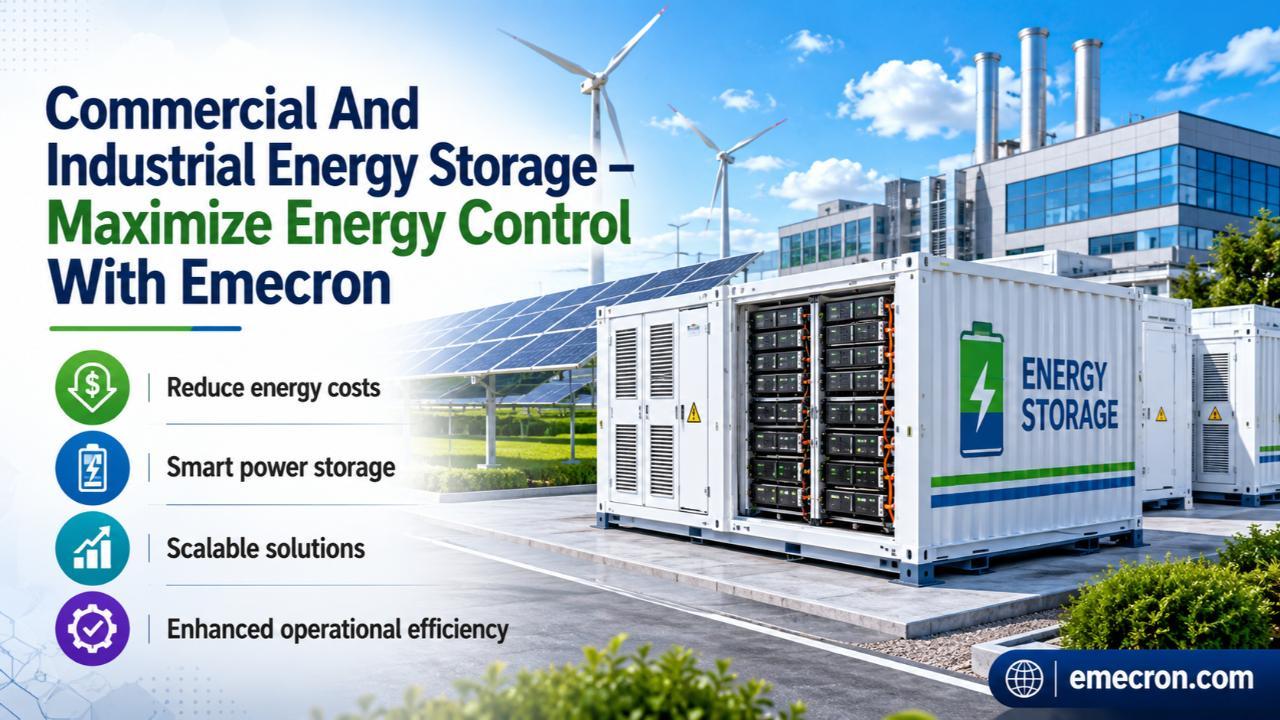
Have you ever looked at a massive factory, a bustling shopping mall, or a sprawling office complex and wondered how much it costs just to keep the lights on? It’s astronomical. For decades, businesses had to just take the punch and pay whatever the utility companies demanded. But things are shifting rapidly. Today, Commercial And Industrial Energy Storage is completely changing the game for enterprises trying to survive in a volatile market. Imagine having a massive, hyper-intelligent battery bank sitting in your facility, acting like a financial shield and an emergency backup all at once. By adopting Commercial and Industrial Energy Storage, companies are no longer just passive consumers of power; they are becoming active managers of their own energy destiny.
Key Features: What’s Inside the Box?
To understand why this is such a massive deal, we need to look under the hood. We aren’t talking about the AA batteries inside your TV remote. These are industrial-grade powerhouses engineered to handle massive electrical loads.
-
Advanced Battery Chemistry: Most modern systems rely on lithium-ion or next-generation flow batteries that can store immense amounts of electricity safely and release it in a fraction of a second.
-
Smart Inverters: These devices act as the brain, converting the stored direct current (DC) into the alternating current (AC) that your building’s machinery and lighting actually run on.
-
Energy Management Software: This is the secret sauce. It uses predictive algorithms to track weather patterns, grid prices, and your facility's historical usage to decide exactly when to save power and when to burn it.
Cutting Your Monthly Bills Without Cutting Corners
The number one reason business owners get excited about this technology is simple: it saves an incredible amount of money. Utilities don’t just charge businesses for the total energy they use; they also charge "demand fees." These fees are based on the single highest peak of energy usage during the month. If your factory turns on all its heavy machinery at 10:00 AM, your spike sets a premium price for the whole month.
With a smart battery system, you can practice what the industry calls peak shaving. Instead of pulling that massive spike of power from the grid, your onsite batteries kick in and supply the extra juice. The utility grid never sees the spike, and your bill stays flat. Furthermore, you can leverage energy arbitrage. This is just a fancy way of saying you buy electricity at 2:00 AM when it’s incredibly cheap, store it, and then run your business off that stored power at 2:00 PM when grid prices are at their absolute highest.
Turning Your Business into a Resilient Power Fortress
Blackouts and brownouts are more than just a minor inconvenience for an industrial plant—they are financial catastrophes. A single hour of lost power can stall assembly lines, spoil temperature-sensitive inventory, and cost hundreds of thousands of dollars in wasted labor.
-
Instantaneous Backup Power: Traditional diesel generators can take several minutes to crank up and stabilize. A modern battery backup reacts in milliseconds, meaning your computers don’t even flicker when the main grid goes down.
-
Decoupling from Grid Instability: As our regional power grids face more strain from extreme weather and aging infrastructure, having an independent energy reservoir ensures your operations remain completely unaffected by external chaos.
-
Protection for Sensitive Machinery: Sudden voltage drops can fry delicate electronic components in specialized industrial equipment. Batteries act as a buffer, smoothing out the electrical current entering your facility.
Crushing Sustainability Goals Realistically
Every corporation today is under pressure to go green, reduce their carbon footprint, and hit net-zero targets. But relying purely on wind or solar has always had a glaring flaw: the sun goes down and the wind stops blowing. This intermittency makes it incredibly tough for a heavy industrial facility to rely solely on renewables.
This is where storage acts as the missing puzzle piece. If your facility has solar panels on the roof, you often generate more power than you can use during the middle of the day. Without a battery, that clean energy is either wasted or sold back to the grid for pennies. By storing that daytime solar energy, you can run your facility on clean, green power long after the sun has set, making your sustainability goals a concrete reality rather than just a marketing slogan.
Conclusion
Investing in energy infrastructure is no longer just about keeping operational costs down—it is about future-proofing your entire enterprise against an unpredictable world. The financial savings from dodging peak demand charges, combined with the priceless peace of mind that comes from total energy independence, make this a pivotal move for any forward-thinking management team. If you are ready to take control of your power dynamics, slash your overhead, and build a truly resilient operation, Emecron is here to engineer the perfect setup tailored precisely to your facility's demands.

 English
 Arabic
 French
 Spanish
 Portuguese
 Deutsch
 Dutch
Dutch
 Italiano
 Russian
 Romaian
 Portuguese (Brazil)
 Greek
Greek