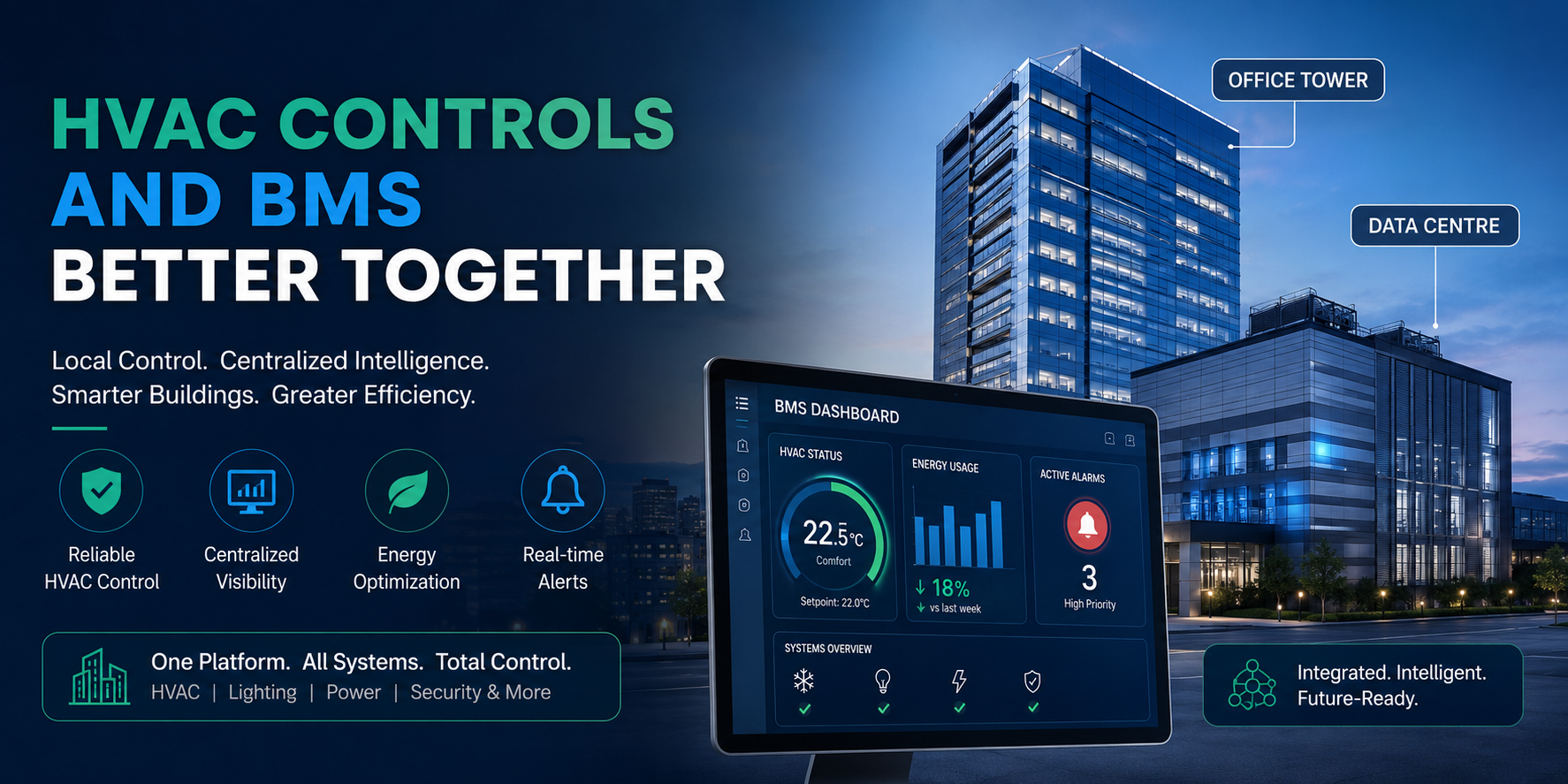
During a sweltering summer week, the central plant of a mixed-use campus struggles to coordinate chilled water supply to both a 20-storey office tower and an adjoining data centre. The office floors show rising complaints about setpoint drift while the data centre logs thermal alarms. Engineers debate whether the issue is with HVAC controls or the site’s Building Management System dashboard—highlighting a common confusion: are HVAC controls and a Building Management System the same, or do they serve different roles?
A Building Management System is the strategic platform that unifies HVAC, lighting, power, fire and access control into a single operational view. For facility managers, understanding how BMS differs from standalone HVAC controls is essential to diagnosing problems, planning upgrades, and achieving energy targets. This article explains the technical distinctions, practical overlaps, and why both are required for resilient, efficient buildings.
What an HVAC control is — focused, localized control
HVAC controls are dedicated devices and control loops that manage a specific piece of plant or terminal equipment: chiller controllers, VFD drives, AHU controllers, thermostat/room controllers, and rooftop unit logic. They implement PID loops, staging logic, sequencing, and safety interlocks locally. These controllers operate with tight real-time constraints and are typically engineered to ensure stable temperature, pressure, airflow, and plant protection independent of supervisory systems.
What a Building Management System is — centralized supervision and coordination
A Building Management System aggregates telemetry and status from field controllers, meters, and sensors, providing higher-level supervisory functions: trend analytics, alarm management, scheduling, setpoint coordination across systems, and operator dashboards. The BMS executes site-wide optimisation strategies—load shedding, demand response participation, plant master control—and maintains historical records required for compliance and energy reporting.
How the two interact
- Data flow: Field HVAC controllers provide I/O and control loops, while the BMS polls or subscribes to those controllers for trend and alarm data.
- Control hierarchy: Critical real-time control remains on the HVAC controller; supervisory setpoints and mode changes come from the BMS.
- Redundancy: Proper design ensures HVAC keeps running if the BMS is offline; the BMS enhances coordination when available.
- Protocols: BACnet, Modbus, and proprietary protocols bridge the devices; open protocol compatibility is a key vendor evaluation factor.
Where confusion arises
Owners often equate the front-end dashboard with control capability. While a BMS control panel visualises and can command HVAC systems, it is not a substitute for robust, properly commissioned HVAC controllers. Problems like thermostat hunting, chiller short-cycling, or AHU balancing usually stem from inadequate field control rather than BMS visualization.
Key features that distinguish a modern BMS
- Scalable architecture that supports expanding control points and distributed sites.
- Multi-system integration — lighting, metering, fire and access-control data alongside HVAC.
- Energy consumption tracking with interval metering and tariff-aware analytics.
- Real-time alerts and role-based notifications for operations staff.
- Remote access and cloud compatibility for centralised oversight across campuses.
- Predictive maintenance capabilities using trending and runtime analytics.
- User-friendly dashboards with customizable operator and executive views.
Use cases where each shines
- HVAC controls: Plant stability, equipment protection, local response to sensor inputs, and deterministic control loops for critical loads such as data centres.
- Building Management System: Site-wide optimisations (e.g., sequencing chillers with building thermal models), demand response, tenant billing, compliance reporting, and centralized alarm management across multiple buildings.
Choosing the right balance
System selection should consider building size, number of control points, and criticality. A data center BMS system requires redundant supervisory layers, precise power and thermal monitoring, and rigorous commissioning. Commercial office towers benefit when the BMS orchestrates diverse HVAC zones and bms lighting control systems for occupancy-based savings. For complex campuses, a hybrid approach—robust local HVAC controls with an enterprise BMS—delivers the best operational resilience.
Procurement and lifecycle factors
- Architecture choice (distributed vs centralised vs cloud) affects latency, resilience, and maintenance patterns.
- Open protocols (BACnet, Modbus) reduce vendor lock-in and simplify integration.
- Consider installation and commissioning scope: proper site acceptance tests are critical to ensure both HVAC controllers and the BMS behave as designed.
- After-sales support and BMS maintenance services matter more over a 10–20 year lifecycle than marginal equipment cost differences.
- For Indian projects, verify local integration capacity and documented project portfolios when selecting a BMS company or system integrator.
Buyer’s checklist
- Confirm the supplier’s experience with similar building types (hospitals, airports, hotels, industrial plants).
- Ask for factory acceptance tests and sample HMI/dashboard views.
- Verify compatibility with existing HVAC controllers and metering systems.
- Ensure clarity on commissioning, training, and AMC offerings.
- Evaluate cybersecurity measures, redundancy strategies, and reporting capabilities for regulatory compliance.
Common mistakes to avoid
- Replacing HVAC controllers with a dashboard-only solution.
- Designing without proper site surveys or load assessments.
- Ignoring future expansion and interoperability needs.
- Selecting purely on upfront cost and skipping commissioning or AMC planning.
- Neglecting cybersecurity or failing to define energy KPIs before design.
Practical next step
If you’re planning upgrades or a new rollout, include both HVAC controls and BMS scope in early design stages. For professional BMS system installation, work with integrators that demonstrate project experience, open-protocol expertise, and strong commissioning discipline to ensure the control hierarchy and dashboard deliver expected performance.
Conclusion
HVAC controls and a Building Management System perform complementary roles: HVAC controllers deliver deterministic, equipment-level control; the BMS provides supervisory coordination, analytics, and enterprise visibility. Selecting engineered solutions, insisting on open protocols and rigorous commissioning, and planning lifecycle support will ensure operational reliability, energy optimisation, and occupant comfort. Properly integrated, these systems turn sensor data into resilient, efficient building operations and measurable savings.

 Arabic
 French
 Spanish
 Portuguese
 Deutsch
 Turkish
 Dutch
Dutch
 Italiano
 Russian
 Romaian
 Portuguese (Brazil)
 Greek
Greek