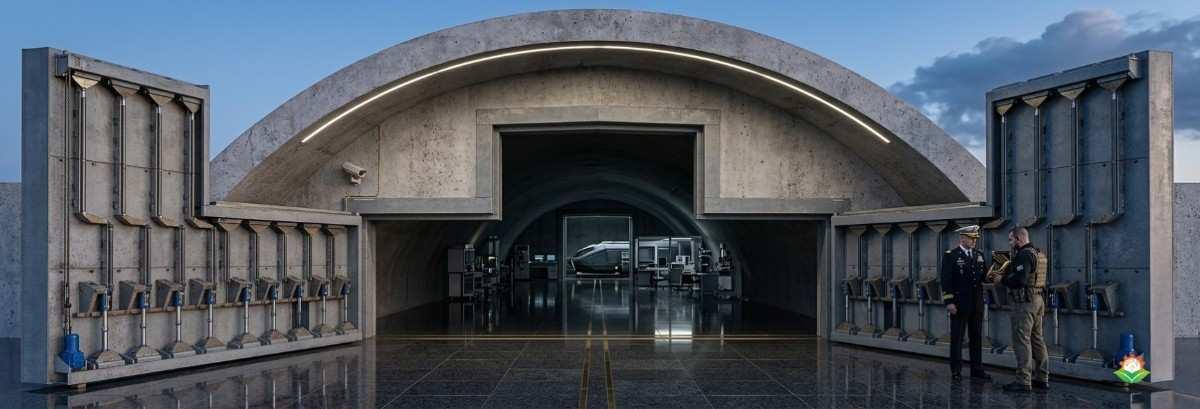
During a night maintenance shift at an MRO facility in Bengaluru, a ground crew member guiding a Boeing 737 into the hangar misjudged the wingtip clearance at the door opening. The aircraft's left winglet made contact with the door frame — a low-speed impact, but enough to trigger a damage assessment that grounded the aircraft for two days. The post-incident review identified inadequate lighting at the door threshold and along the door frame edges as a contributing factor. The hangar interior was well-lit. The door opening itself was not.
Lighting at and around a hangar door is a safety-critical system, not an afterthought to the door design. It directly affects aircraft movement safety, personnel protection, and the operational efficiency of the facility at all hours.
Why Hangar Door Lighting Is a Distinct Design Requirement
The door opening of an aircraft hangar is a transition zone — the point where an aircraft moves from the controlled environment of the hangar apron to the building interior, or vice versa. This transition involves large, slow-moving aircraft, ground support equipment, towing vehicles, and personnel, often simultaneously. The lighting conditions at this zone determine whether that movement is safe or whether the geometry of the aircraft relative to the door opening has to be assessed on incomplete visual information.
Interior hangar lighting is typically designed for the maintenance work performed inside. It is not designed to illuminate the door threshold, the door frame edges, or the apron immediately in front of the opening. These zones require dedicated lighting that addresses the specific visual tasks performed there.
The Three Lighting Zones Around a Hangar Door
Designing Coverage for Each Part of the Opening
Threshold and transition lighting covers the floor zone at the door base and the immediate apron approach. This is where towing equipment positions, where marshalling personnel stand, and where the ground crew managing wingtip clearance needs to see both the aircraft geometry and the door structure simultaneously. Illuminance levels at threshold level should support accurate distance judgement — a minimum of 100 lux at floor level is a practical working standard for active aircraft movement operations, with higher levels appropriate for facilities conducting night maintenance on a regular schedule.
Door frame edge lighting is the most frequently neglected element in hangar lighting design. The vertical door frame edges and the head structure of the opening define the clearance envelope the aircraft must pass through. Under standard ceiling-mounted interior lighting, these structural elements cast shadows or fall into relative darkness because they project inward from the bright interior space. Dedicated LED strip or flood lighting mounted on the door frame itself, or on adjacent structure, illuminates the edges in a way that makes clearance assessment straightforward for ground crews.
Apron floodlighting serves the external face of the hangar, covering the manoeuvring zone in front of the door. This lighting must be positioned to avoid glare directed at aircraft crew or ground personnel — a common error when floodlights are mounted too low or aimed directly at the door face from close range. Pole-mounted or building-eave-mounted floodlights aimed to illuminate the apron surface rather than the door face achieve better coverage with less glare impact.
Integration with the Door System
Modern aircraft hangar door systems — including automated sliding and bi-fold configurations — increasingly integrate lighting as a designed element rather than a field-fitted addition. Door-frame-mounted LED lighting that activates automatically when the door is in the open position provides continuous threshold illumination without requiring separate switching or manual operation.
This integration matters for MRO facilities and military airbases where door operations occur frequently across day and night shifts. A lighting system that requires manual activation adds a procedural step that gets skipped during high-tempo operations, precisely the conditions where lighting is most important.
Automation integration also allows door lighting to interlock with aircraft movement authorisation systems — where these exist — so that threshold lighting is confirmed active before door movement begins. This level of integration is specified in detail for defence facilities where procedural compliance is a safety requirement. Technical documentation covering integrated door and facility systems, including lighting and control integration for defence-standard installations, is available through Hangar door engineering resources covering these specifications.
LED Specification for Aviation Environments
LED technology has become the standard for hangar door lighting for well-established reasons. Long service life reduces maintenance access requirements — replacing luminaires mounted on tall door frames or high structural positions is operationally disruptive and requires elevated access equipment. LED sources rated at 50,000 hours substantially reduce this maintenance burden compared to fluorescent or metal halide alternatives.
Colour rendering is relevant for maintenance environments. A colour rendering index (CRI) of 80 or above ensures that component identification, colour-coded wiring, and surface condition assessment at the door threshold are not compromised by the light source. High-bay LED fixtures rated CRI 80+ are widely available and should be standard specification for MRO and aerospace manufacturing hangar applications.
For coastal facilities — where hangar door manufacturers in India specify corrosion-resistant hardware throughout the door system — luminaire enclosures should be rated IP65 or above. Salt-laden air and humidity at coastal sites degrade standard IP44 or IP54 enclosures within a few years, leading to premature luminaire failure at the door positions that are hardest to access for replacement.
Sigma Power Tech hangar door installations designed for coastal defence and naval aviation facilities incorporate lighting specifications matched to the marine environment, treating luminaire protection and door system corrosion protection as elements of the same environmental specification rather than separate scopes.
Common Mistakes in Hangar Door Lighting Design
Relying on interior ceiling lighting to illuminate the door opening is the most persistent error. Ceiling fixtures designed for the working area of the hangar are positioned for that task — the geometry is wrong for door threshold illumination, and the result is predictable shadow and under-illumination at the most safety-critical point.
Specifying lighting only for the hangar interior and leaving the apron approach to existing airfield lighting assumes those systems provide adequate coverage at the door level. Airfield lighting is designed for aircraft navigation, not for close-proximity ground handling at specific building openings. The two purposes require different illuminance levels and coverage patterns.
Ignoring glare control in apron floodlight specification creates conditions where ground personnel face direct glare from floodlights when looking outward through the door opening — the direction they need to look when managing aircraft entry. Anti-glare louvres and correct aiming angles are not optional features on apron-facing fixtures.
Conclusion
Hangar door lighting is a safety system that protects aircraft during the highest-risk phase of ground movement — the transition through the hangar opening. It requires dedicated design for the threshold zone, the door frame edges, and the apron approach, with specifications matched to the facility's operational tempo, environmental exposure, and integration with door automation systems.
The incident that damages a winglet or injures a ground crew member at a poorly lit door opening is preventable. Lighting designed specifically for the door zone, integrated with the door system, and maintained to ensure consistent performance throughout the facility's operational life is the standard that aviation infrastructure should consistently meet.

 English
 Arabic
 French
 Spanish
 Portuguese
 Turkish
 Dutch
Dutch
 Italiano
 Russian
 Romaian
 Portuguese (Brazil)
 Greek
Greek