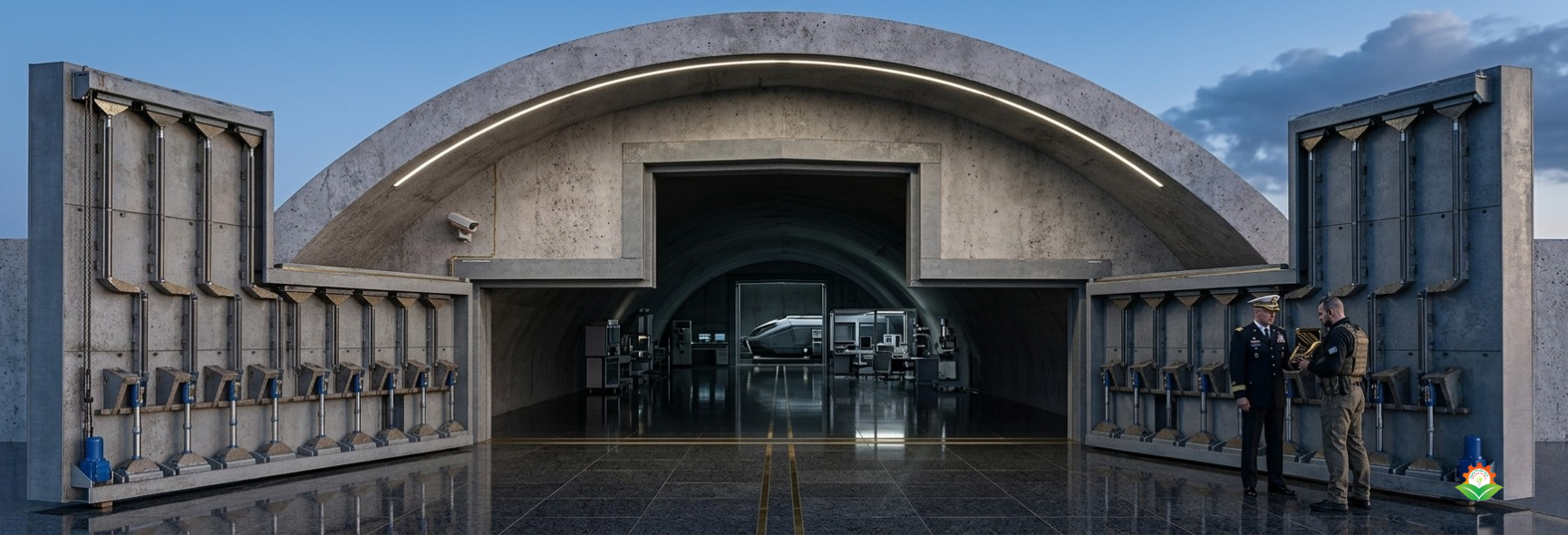
A foggy dawn at a regional MRO: a C-130 taxis toward a hangar while controllers coordinate a single operator on the ramp. The hangar door must open smoothly and predictably—any delay or uncontrolled motion risks damage, personnel safety, and flight delays. For facility managers and engineers, automating a hangar door is not just convenience; it’s an operational necessity that requires careful engineering and systems integration.
Automating a hangar door changes how an aviation facility operates by improving safety, reducing cycle time, and enabling remote control integrated with security and building systems. A correctly engineered hangar door automation delivers repeatable performance under wind, snow, and high-cycle demands while protecting aircraft and personnel. This article explains what automation entails, engineering principles, benefits, risks, and procurement considerations for aircraft hangar doors.
What hangar door automation is and how it works
Automation replaces manual winches and consoles with electric or hydraulic drives, PLC-based controllers, and sensor suites. Systems include variable-frequency drives (VFDs) for smooth acceleration, hydraulic units for high-torque applications, and redundant safety circuits. Controls integrate limit switches, torque sensing, safety edges, photo-eyes, and emergency-stop logic to prevent entrapment or uncontrolled motion.
Key engineering principles
-
Dynamic load management: drives and bracing must accommodate door mass, wind pressure, and transient forces during start/stop cycles.
-
Redundancy: critical installations use dual motors, backup power, and fail-safe brakes to secure doors during power loss.
-
Control logic: PLCs manage soft-start/stop, synchronization on multiple panels, and interlocks with perimeter security and apron systems.
-
Thermal and corrosion design: drives and exposed components need protection or heating in extreme climates or corrosive environments.
-
Structural interfaces: anchorages and header beams must be engineered to accept drive reactions and lateral loads without transferring excessive forces to non-structural finishes.
Operational Advantages
Automated doors reduce manpower required for single-operator movements and standardise cycle times for faster turnarounds. Integration with access control and airfield lighting improves security and coordinated operations. Diagnostics and remote monitoring enable predictive maintenance, reducing unexpected downtime.
Safety considerations
Automation introduces failure modes—uncommanded movement, sensor failure, or drive faults. Mitigation includes multiple redundant safety circuits, certified safety relays, mechanical locks or latches, and regular proof-load and functional testing. For high-security or defence hangars, blast-rated latches and emergency manual override procedures are mandatory.
Weather resistance and structural performance
Automation must perform under local wind and environmental loads. Drives and controllers should have ingress protection (IP) ratings appropriate to exposure. Stainless or galvanised hardware, plus protective housings for electrical components, ensure longevity in marine or industrial atmospheres. Design the automation to hold doors securely against wind-driven pressures.
Automation features to prioritise
-
Soft-start/soft-stop via VFDs to reduce dynamic shock.
-
Synchronized multi-panel control for uniform loads.
-
Redundant braking and mechanical locks for power loss.
-
Safety edges, light curtains, and photo-eyes to prevent entrapment.
-
Remote diagnostics, event logging, and BMS integration.
-
Programmable interlocks with apron operations and security.
-
Manual override accessible and clearly documented.
Space optimisation and aircraft protection
Automation choices affect apron layout and clearances. Vertical-lift doors with powerful drives save apron depth compared to sliding doors but demand robust headers. Properly controlled openings reduce pressure pulses and dust ingress, protecting aircraft finishes and avionics.
Maintenance requirements and long-term value
Automated systems require scheduled inspections—drive oil checks for hydraulics, motor bearing inspections, cable tension monitoring, and sensor calibration. Remote monitoring makes condition-based maintenance feasible, which lowers lifecycle cost despite higher initial investment.
Applications and suitability
Automation is suitable for MRO facilities, military airbases, aerospace manufacturing, helicopter hangars, and large logistics hubs. Defence installations often require hardened automation with blast-resistant locking and rapid emergency procedures. Smaller GA hangars may opt for simpler electric drives with manual backup.
Cost and investment factors
Automation adds cost elements: higher-spec drives, control cabinets, integration with BMS/security, redundant power supplies, and commissioning time. Costs scale with door dimensions, required wind-load certification, and customization (e.g., blast protection). However, improved throughput, reduced manpower, and lower downtime often justify the investment.
Buyer’s guide: selecting automation providers and installers
-
Experience: choose suppliers with proven hangar door design and automation projects.
-
Engineering capability: confirm structural, electrical, and control expertise.
-
Standards and certifications: request IEC/EN safety standards, IP ratings, and compliance documentation.
-
Integration support: verify BMS and security system interfacing capability.
-
Commissioning and training: ensure on-site commissioning and operator training.
-
Maintenance and spares: confirm availability of critical spare parts and service SLAs.
-
Local references: check projects from regional hangar door manufacturers in India when procuring locally.
Common mistakes to avoid
-
Underspecifying drives relative to door mass and wind loads.
-
Omitting redundant brakes or manual emergency overrides.
-
Neglecting ingress protection for electrical components.
-
Skipping full system commissioning and worst-case operational tests.
-
Choosing automation without considering apron geometry or security interlocks.
For detailed automation architectures and options that include security and blast-resistant features, review technical resources from experienced suppliers; this reference on Hangar door systems explains integration and performance considerations.
Conclusion
Yes—you can and often should automate your hangar door, but success depends on engineering the drive, controls, and structural interfaces to local loads, operational procedures, and safety requirements. Prioritise redundancy, certified safety systems, and supplier experience to achieve reliable, efficient, and secure hangar operations.

 English
 French
 Spanish
 Portuguese
 Deutsch
 Turkish
 Dutch
Dutch
 Italiano
 Russian
 Romaian
 Portuguese (Brazil)
 Greek
Greek