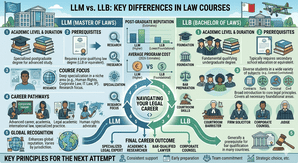
Every other week, a student or a parent walks into my office with the same confusion. “My daughter wants to study law in the UK. But should she do LLB or LLM? She already has a BA in English. Can she do LLM directly?” These questions come up so often that I have started keeping a simple comparison chart ready. But a chart does not tell the whole story. Let me walk you through the real differences, because choosing the wrong one can waste a year of your life and a lot of money.
The Basic Distinction: One is a First Degree, One is a Specialisation
Let me put it as simply as I can. The LLB (Bachelor of Laws) is an undergraduate degree. It is your entry ticket into the legal profession if you have never studied law before. The LLM (Master of Laws) is a postgraduate degree. You do it after you already have a law degree, or in some cases after a non-law degree with a conversion course.
Think of it this way. LLB teaches you how to become a lawyer. LLM teaches you how to become a specialist in one area of law.
If you have never studied law before and you want to qualify as a solicitor or barrister in the UK, you start with an LLB. If you already have an LLB or a law conversion qualification, and you want to deepen your knowledge in, say, international arbitration or human rights law, then you do an LLM.
Who Is the LLB For?
The LLB is for students straight out of Class 12. It is also for working professionals who have never studied law but want to switch careers, though that path usually requires a two-year accelerated LLB for graduates.
When you study LLB in UK, you are committing to a three-year program (four years in Scotland). The curriculum covers the foundations of English law: contract, tort, criminal, constitutional, property, and equity. By the end, you have a qualifying law degree recognised by the Solicitors Regulation Authority and the Bar Standards Board.
I see Indian students choosing the LLB for one of two reasons. Either they are 18 or 19 years old, fresh out of CBSE or state board, and they want to build a legal career from scratch. Or they are slightly older, have a non-law degree, and have decided to take the plunge into law through a two-year graduate LLB.
The entry requirements for LLB are reasonable. Most UK universities ask for 65-75% in Class 12 and an IELTS score of 6.0 to 6.5. Some top universities like UCL or LSE ask for 85% and above. But there are plenty of good options in the middle range.
Who Is the LLM For?
The LLM is a different animal. When you study LLM in UK, you are usually already a law graduate already. You have an LLB from India or the UK. Or you have a non-law degree but have completed a law conversion course like the PGDL (Postgraduate Diploma in Law).
The LLM is one year long. It is intense and specialised. You choose a pathway—international business law, human rights, intellectual property, maritime law, whatever interests you. You take advanced seminars, write a dissertation, and often work on research projects with faculty.
I meet two types of Indian students who want an LLM. The first is the fresh law graduate from India. They have a five-year integrated BA LLB or a three-year LLB. They want a UK qualification to boost their CV and maybe get a foot in the door of international law firms. The second is the experienced lawyer or legal professional—say, someone who has worked in corporate law for a few years and now wants to specialise in cross-border mergers or international arbitration.
Entry requirements for LLM are higher. You generally need a 2:1 or above in your first law degree (roughly 60-65% from a good Indian university). IELTS 6.5 to 7.0 is common. Some competitive programmes ask for work experience or a research proposal.
The Key Differences at a Glance
Let me list the practical differences, because that is what students actually care about.
Duration: LLB is three years (or two for graduate entry). LLM is one year.
Who should apply: LLB is for non-law students or school-leavers. LLM is for law graduates or conversion students.
Content: LLB covers all core legal subjects broadly. LLM covers one area in great depth.
Qualifying status: LLB is a qualifying law degree for practice in England and Wales. A standard LLM is not a qualifying degree unless it includes a conversion component (like an LLM in Legal Practice).
Cost: LLB costs between £15,000 and £30,000 per year depending on the university. LLM costs between £15,000 and £40,000 for the whole year.
Career outcome: LLB prepares you to start legal training (SQE for solicitors, Bar Course for barristers). LLM prepares you for specialised roles or academic research, but you still need the same professional training afterwards.
The Indian Student Confusion I See Most Often
Here is the most common mistake. An Indian student with a BA in Economics decides they want to become a lawyer. They apply directly to an LLM in the UK, thinking it is a shortcut. They get rejected or, worse, they get admitted to an LLM that is not a qualifying degree. They spend a year and £20,000, and then they discover they still cannot practice law because they never did the foundational LLB or conversion course.
Please do not do this. If you have no prior law degree, you need to either do an LLB (three years) or a law conversion course like the PGDL (one year) before you can do an LLM or enter professional training. There are no shortcuts.
The other common confusion is about the LLM as a booster for Indian lawyers. Many Indian law graduates think a UK LLM will automatically make them eligible to practise in the UK. It will not. You still need to pass the SQE exams and complete qualifying work experience. The LLM helps with knowledge and networking, but it is not a licence.
Which One Should You Choose?
After years of guiding Indian students, here is my honest advice.
Choose the study LLB in UK route if: you are a school-leaver or a non-law graduate with no legal background, you want to qualify as a solicitor or barrister in the UK or a common law jurisdiction, you are willing to invest three years, or you want a thorough foundation before specialising later.
Choose the study LLM in UK route if: you already have an LLB or a conversion degree, you want to deepen expertise in a niche area, you are a practising lawyer looking for a career boost or international exposure, or you are considering a PhD in law.
Do not choose an LLM just because it is shorter. Do not choose an LLB just because you think it is easier. Be honest about where you are in your legal education. One is a starting line. The other is a finishing line for advanced study.
The Final Word from Our Desk
I have seen students flourish on both paths. The ones who succeed are the ones who understood the difference before they applied. They did not waste time on the wrong degree. They did not spend money on something that would not get them where they wanted to go.
Sit down with your marksheet, your budget, and your career goal. Then decide. And if you are still confused, talk to someone who has placed students into both LLB and LLM programmes in the UK. That conversation will save you from an expensive mistake.

 English
 Arabic
 French
 Spanish
 Portuguese
 Deutsch
 Turkish
 Dutch
Dutch
 Italiano
 Russian
 Portuguese (Brazil)
 Greek
Greek