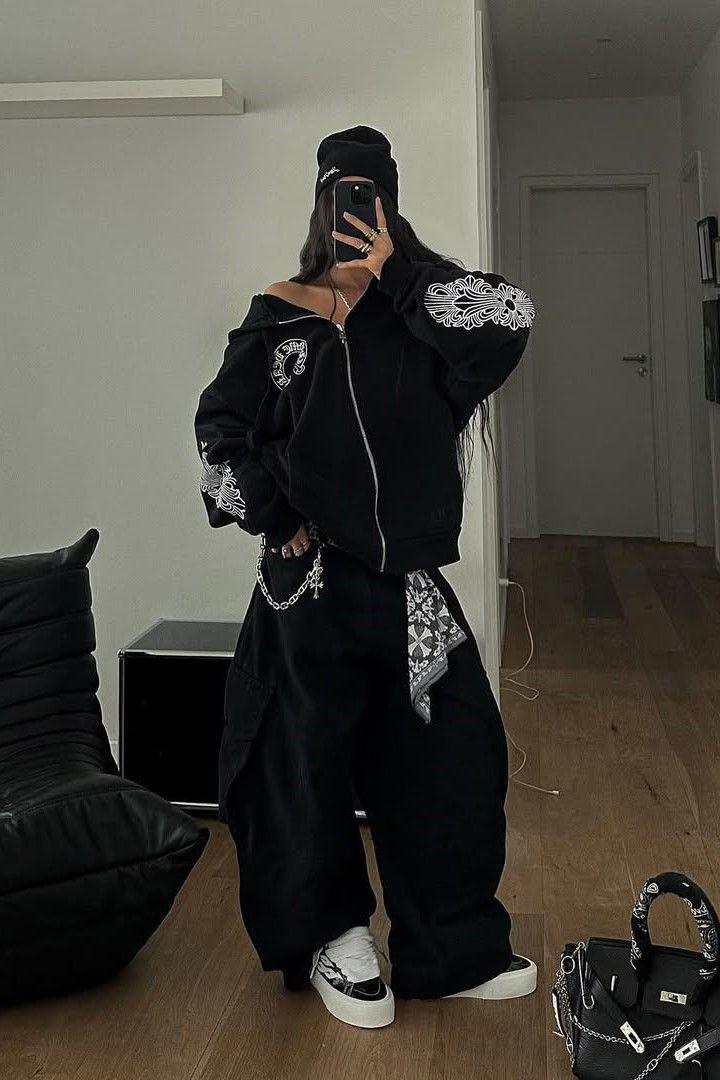
The fashion ecosystem, often accused of cyclical banality, has found two unlikely protagonists in Comme Des Garçons and Chrome Hearts—houses that repudiate the very notion of ephemeral trend cycles. Rei Kawakubo’s perennial interrogation of silhouette and proportion, achieved through asymmetric cuts, deliberate fraying, and what some critics call “anti-fashion” structuralism, forces the wearer into a philosophical dialogue with clothing as sculpture rather than mere adornment. Her garments, frequently punctuated by bulbous protrusions, gaping orifices, or unfinished hems, challenge the sartorial status quo with an audacity that borders on the confrontational, yet it is precisely this intellectual rigor that has cultivated a cult following among those weary of logo-centric ostentation.
Chrome Hearts’ Gothic Revival:
While Kawakubo navigates the realm of the cerebral, Chrome Hearts harnesses a distinctly different but equally potent energy: the romanticism of American biker subculture filtered through a lens of medieval iconography and rock-and-roll hedonism. Founded by Richard Stark in 1988, the brand has never wavered from its devotion to handcrafted sterling silver, employing intricate filigree, dagger motifs, floral crosses, and cemetery-inspired lettering that feels simultaneously sacred and profane. Each piece, from oversized crucifix pendants to leather jackets embossed with Gothic script, carries the weight of artisan hours, rendering mass-produced luxury accessories almost laughably sterile by comparison.
The Unlikely Symbiosis of Minimalist Chaos and Maximalist Decadence
At first glance, pairing the stark, often monochromatic deconstruction of Comme Des Garçons with the ornate, dagger-encrusted bravado of Chrome Hearts seems like a recipe for visual cacophony. Yet the alchemy occurs in their shared rejection of conventional beauty—one embraces ugliness as a virtue, while the other weaponizes ornamentation to the point of rebellious excess. Wearing a crumpled, sack-like Comme Des Garçons blazer atop a Chrome Hearts silver choker and patchwork denim vest creates a tension that is palpably modern, signaling an individual who respects fashion history but refuses to be imprisoned by its rules.
Navigating the Subversive Power of Androgyny Across Both Houses
Neither brand has historically bowed to the strictures of gendered dressing, and this mutual disregard forms a foundational pillar of their contemporary edge. Kawakubo famously declared that she “designs for the body, not for gender,” producing oversized, shapeless forms that obscure anatomical cues, while Chrome Hearts’ unisex rings, leather goods, and eyewear blur the lines between masculine bravado and feminine mystique. This androgynous permeability allows for a wardrobe that transcends binary limitations, offering a psychological liberation seldom found in houses still segmenting runways into “men’s” and “women’s” presentations.
Material Provocation:
A deep appreciation for materiality distinguishes both labels from their contemporaries, as they prioritize tactility and aging over pristine perfection. Comme Des Garçons regularly employs industrial felt, bonded jersey, polyester blends that mimic decay, and even transparent vinyl to create garments that warp with wear, deliberately eschewing the longevity associated with luxury staples. Conversely, Chrome Hearts celebrates the patination of its silver—the subtle darkening in crevices, the micro-abrasions from daily friction—as a narrative of the owner’s life, transforming jewelry into diaristic artifacts rather than static investments.
The Hoodie Reimagined:
Perhaps no garment better illustrates the convergence of these two worlds than the hoodie, an item elevated from utilitarian loungewear to high-art statement piece. commedesgarcos.com’ iconic “Play” line, with its bug-eyed heart logo, offers a playful entry point, but the brand’s mainline hoodies feature spliced sleeves, exposed seams, and fabric combinations that defy ergonomic logic. Chrome Hearts retaliates with hoodies densely embroidered with cross motifs, Maltese crosses, and leather patch appliqués, their weight and construction rendering them almost armor-like. To own both is to command a spectrum of casual subversion few can replicate.
Cultivating Rarity Through Distribution:
Neither brand courts ubiquity, and their scarcity strategies verge on the draconian, yet this friction only intensifies desirability. Comme Des Garçons maintains a labyrinthine network of flagship boutiques like Dover Street Market, where merchandise rotates unpredictably and prices induce sharp inhalations, while Chrome Hearts operates its own retail outposts—often requiring referrals or months-long waitlists for custom leatherwork and specialty jewelry pieces. Such deliberate inaccessibility functions as a silent filter, ensuring that those who finally secure a patchwork flannel or a silver cemetery ring have traversed a gauntlet of patience and financial commitment.
Styling the Dichotomy:
For the curious neophyte hoping to harness this fashion edge without plunging into full-blown avant-garde chaos, strategic hybridization offers the gentlest introduction. Commence with a relatively subdued Comme Des Garçons button-down shirt—perhaps one with a single asymmetrical ruffle or a half-detached collar—paired with straight-leg black denim and a single Chrome Hearts leather bracelet adorned with a small dagger charm. Alternatively, drape a Chrome Hearts beanie over a voluminous Comme Des Garçons wool coat, allowing the beanie’s Gothic lettering to punctuate the coat’s architectural expanse. The objective is not harmony but intentional friction.
Investment Horizon:
Unlike seasonal designer handbags that flood resale markets within months, both Comme Des Garçons and Chrome Hearts exhibit remarkable value retention, with certain rare pieces appreciating significantly over time. Limited-run Kawakubo collaborations (e.g., with Lewis Leathers or Nike) frequently command multiples of their original retail price, while Chrome Hearts’ discontinued silver lines—particularly those from the late 1990s—are now coveted archival trophies. Viewing acquisitions through this lens transforms shopping from hedonistic consumption into a form of wearable asset management, a compelling argument for those wavering on a 600silverringora600silverringora1,500 deconstructed blazer.
The Psychological Shift:
Ultimately, embracing the combined ethos of Comme Des Garçons and Chrome Hearts extends beyond aesthetics into a deliberate psychological posture—one that rejects the placid conformity of minimalist normcore and the shouty desperation of logomania alike. Kawakubo’s garments ask you to tolerate stares and unsolicited commentary, to find power in being misunderstood; Chrome Hearts asks you to revel in the weight of silver against your sternum, to feel the cool density of rebellion. Together, they furnish a vocabulary for the individual who has tired of polite fashion and seeks instead the jagged, the dissonant, and the memorably strange.

 English
 Arabic
 Spanish
 Portuguese
 Deutsch
 Turkish
 Dutch
Dutch
 Italiano
 Russian
 Romaian
 Portuguese (Brazil)
 Greek
Greek