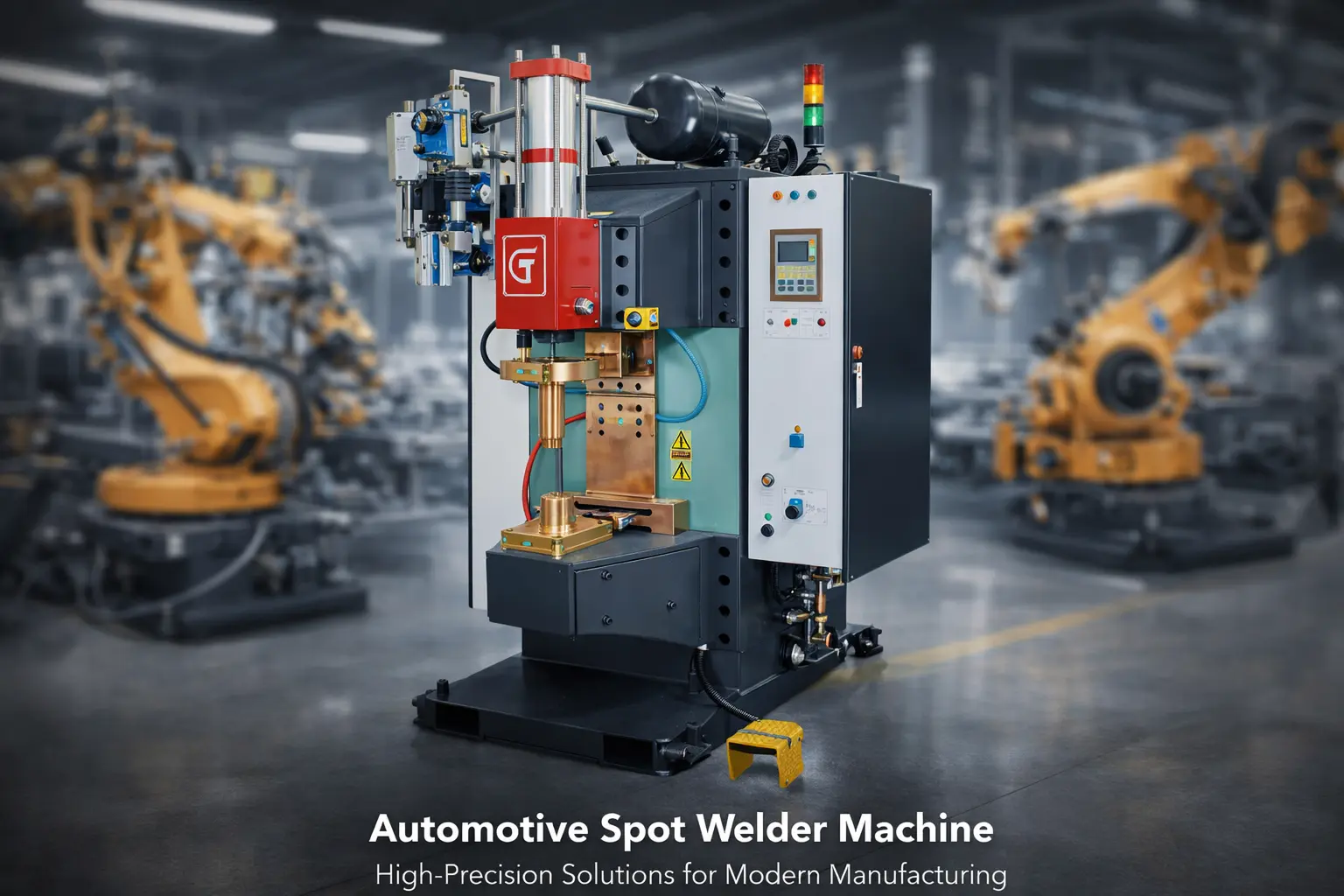
In today’s high-speed automotive manufacturing environment, precision, repeatability, and structural integrity are non-negotiable. The automotive spot welder has become one of the most critical pieces of equipment in body-in-white (BIW) assembly lines, enabling OEMs and tier suppliers to achieve strong, consistent, and cost-efficient metal joining.
As vehicle structures evolve with high-strength steels (HSS), aluminum alloys, and multi-material designs, resistance spot welding technology especially advanced MFDC systems continues to dominate large-scale production. Heron Welder provides industrial-grade solutions designed to meet these demanding automotive requirements with stability and automation readiness.
What Is an Automotive Spot Welder?
An automotive spot welder is a type of resistance welding machine used to join overlapping metal sheets by applying electrical current, pressure, and controlled heat at specific points (“spots”).
The process forms a molten “weld nugget” between sheets, which solidifies under pressure, creating a strong metallurgical bond without filler material.
In automotive production, this method is widely used because it is:
- Extremely fast (milliseconds per weld)
- Highly repeatable for mass production
- Easy to automate with robotics
- Cost-efficient for sheet metal assembly
Resistance spot welding remains the backbone of automotive body construction, with thousands of weld points used in a single vehicle structure.
How Automotive Spot Welding Works
The working principle is based on resistance heating:
1. Electrode Clamping
Copper electrodes clamp two or more metal sheets together with controlled force.
2. Current Application
A high electrical current passes through the contact point.
3. Resistance Heat Generation
Heat is generated due to electrical resistance at the interface.
4. Weld Nugget Formation
Metal locally melts and fuses into a solid joint when cooled under pressure.
5. Solid-State Bonding
The result is a strong, localized weld spot with minimal distortion.
Modern systems such as MFDC (Medium Frequency DC) spot welders improve control over current delivery, ensuring higher stability and consistency in weld quality.
Key Types of Automotive Spot Welders
Automotive production lines use different resistance welding technologies depending on material and application:
1. AC Spot Welders
Traditional systems used for basic sheet metal joining.
- Lower cost
- Higher energy fluctuation
- Suitable for light-duty production
2. MFDC Spot Welders
Advanced inverter-based systems widely used in automotive manufacturing.
Benefits include:
- Stable DC current output
- Lower energy consumption
- Better weld consistency
- Strong compatibility with automation systems
3. Capacitor Discharge (CD) Spot Welders
Used for fast, high-energy bursts—ideal for thin materials or precision components.
4. Servo-Controlled Spot Welders
Provide precise electrode force control, improving weld repeatability for modern OEM requirements.
Automotive Applications of Spot Welding
Automotive spot welders are essential in nearly every stage of vehicle body production:
Body-in-White (BIW)
- Door panels
- Roof structures
- Floor assemblies
- Side frames
Powertrain & Chassis Components
- Shock absorbers
- Brackets and reinforcements
- Structural mounts
EV Manufacturing
- Battery trays
- Aluminum housings
- Lightweight structural frames
Interior & Sub-Assemblies
- Seat frames
- Support brackets
- Reinforcement joints
A modern vehicle may contain thousands of spot welds ensuring rigidity and crash safety performance.
Advantages of Automotive Spot Welding
1. High Production Speed
Automotive spot welders deliver welds in milliseconds, making them ideal for mass production lines.
2. Strong and Reliable Joints
Properly controlled weld nuggets ensure excellent mechanical strength and durability.
3. Automation Compatibility
Easily integrated into robotic arms and automated production lines.
4. Cost Efficiency
No filler materials required and minimal post-processing reduces manufacturing cost.
5. Clean and Precise Welding
No sparks, minimal distortion, and controlled heat-affected zones.
Common Challenges in Automotive Spot Welding
Despite its advantages, manufacturers face several challenges:
Electrode Wear
High production cycles cause electrode degradation, affecting weld consistency.
Material Complexity
Modern vehicles use:
- High-strength steel
- Galvanized coatings
- Aluminum alloys
These materials require precise current and force control.
Power Instability
Poorly controlled systems may lead to inconsistent weld quality across production lines.
Quality Monitoring
Ensuring each weld meets safety standards requires real-time monitoring systems and process control.
Why MFDC Technology Leads Automotive Spot Welding
MFDC (Medium Frequency Direct Current) systems are now the industry standard for automotive OEMs.
Key advantages:
- Faster current rise time
- Stable energy output
- Reduced power grid load
- Improved weld consistency across materials
Heron’s MFDC spot welding solutions are engineered specifically for these challenges, ensuring stable performance even in high-volume automotive production environments.
Best Practices for Automotive Spot Welding
To achieve optimal results, manufacturers should follow these practices:
- Maintain proper electrode force calibration
- Optimize welding current and time per material
- Regularly dress or replace electrodes
- Use real-time weld monitoring systems
- Ensure proper cooling systems in high-duty cycles
- Integrate automation for repeatability
Heron Welder: Engineering Automotive Welding Excellence
Heron Welder specializes in industrial resistance welding and automated joining systems, including:
- Spot welding machines (AC, MFDC, servo)
- Projection welding systems
- Clinching technology
- Self-pierce riveting (FSPR)
- Automated welding production lines
With decades of engineering expertise, Heron delivers solutions designed for:
- Automotive OEMs
- Tier 1 & Tier 2 suppliers
- EV manufacturers
- Automation integrators
Every system is built to support high-volume production, precision control, and long-term reliability.
FAQs: Automotive Spot Welder
1. What materials can an automotive spot welder join?
It can join mild steel, high-strength steel, stainless steel, galvanized steel, and selected aluminum alloys depending on system configuration.
2. Why is spot welding preferred in automotive manufacturing?
Because it is fast, cost-effective, highly repeatable, and easily automated for mass production.
3. What is the difference between AC and MFDC spot welders?
MFDC systems provide more stable current, better energy efficiency, and improved weld consistency compared to AC systems.
4. Can spot welding be used for electric vehicles?
Yes, it is widely used in EV battery trays, structural frames, and lightweight aluminum assemblies.
5. How can weld quality be improved in production lines?
By optimizing electrode force, current control, weld time, and using advanced MFDC systems with monitoring.
Final Thoughts
The automotive spot welder remains a cornerstone of modern vehicle manufacturing, enabling fast, precise, and reliable metal joining at industrial scale. As automotive design evolves toward lightweight materials and electric mobility, advanced resistance welding technologies like MFDC and automated spot welding systems are becoming essential for maintaining production efficiency and quality standards.
Request a Custom Welding Solution from Heron
Looking to upgrade your automotive welding line or improve production efficiency?
Heron Welder provides custom-engineered spot welding and automation solutions tailored for automotive manufacturing needs.
Contact Heron today to request a quote or consult with our engineering team for a fully customized resistance welding system.

 Arabic
 French
 Spanish
 Portuguese
 Deutsch
 Turkish
 Dutch
Dutch
 Italiano
 Russian
 Romaian
 Portuguese (Brazil)
 Greek
Greek