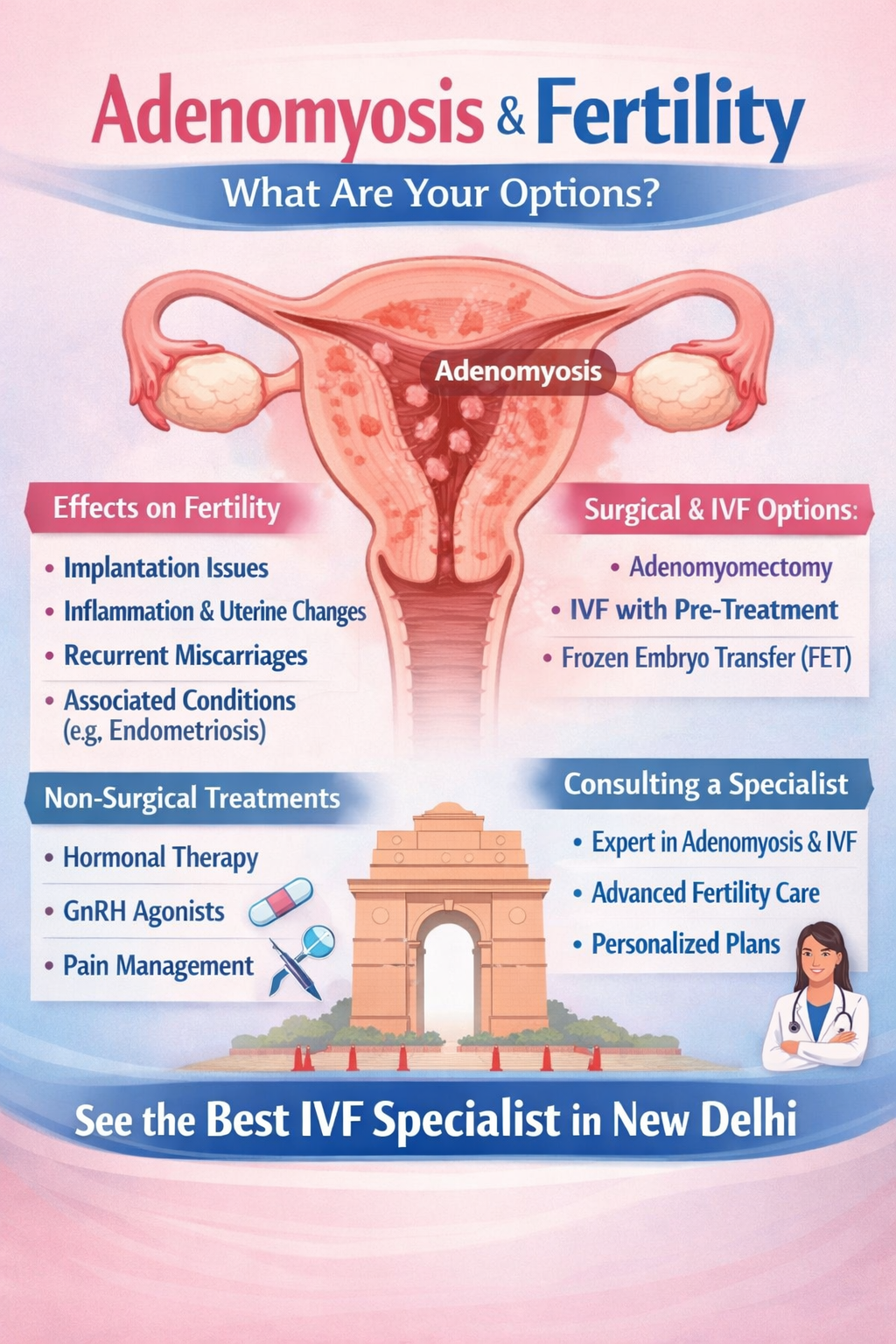
1. What is adenomyosis? (brief overview).
Adenomyosis is a condition where tissue similar to the lining of the uterus (the endometrium) grows into the muscular wall of the uterus (the myometrium). This can make the uterus thicker, larger, and more prone to heavy bleeding, cramping, or chronic pelvic pain. It most commonly affects women in their 30s and 40s, but it can occur at other ages too.
Adenomyosis can affect fertility — learn causes, diagnosis, medical and surgical options, IVF strategies, pregnancy tips, and when to consult the best IVF specialist in New Delhi
While adenomyosis itself is not cancer and is not life-threatening, it can interfere with quality of life-- including fertility and the ability to carry a pregnancy. Understanding how it affects fertility and what options are available is the first step toward getting the right care.
2. How adenomyosis affects fertility.
Adenomyosis can reduce fertility in several ways-- sometimes subtly, sometimes clearly. Here are the main mechanisms:.
Uterine environment changes: Adenomyosis can lead to inflammation and altered contractility of the uterus (how the uterine muscle contracts). This may interfere with embryo implantation and early pregnancy maintenance.
Impaired implantation: Structural changes and a disrupted lining mean the embryo may have a harder time attaching and growing in the uterus.
Associated conditions: Many women with adenomyosis also have endometriosis, fibroids, or pelvic adhesions-- each of which can independently reduce fertility.
Altered blood flow: Thickened uterine walls may change blood flow to the endometrium, creating an environment less receptive to an embryo.
Repeated pregnancy loss: Some women with adenomyosis report higher rates of miscarriage-- likely because of implantation problems or early placental issues.
It's important to note that adenomyosis does not always cause infertility. Some women conceive naturally despite adenomyosis, while others may need medical or surgical assistance.
3. Symptoms and diagnosis-- what to expect.
Symptoms can vary. Common signs include:.
Heavy or prolonged menstrual bleeding.
Severe menstrual cramps (dysmenorrhea).
Chronic pelvic pain.
Pain during intercourse (dyspareunia).
An enlarged or tender uterus.
Diagnosis tools:.
Transvaginal ultrasound (TVUS): Often the first imaging test; may show a bulky uterus, heterogeneous myometrium, or cystic spaces.
MRI: More sensitive and specific than ultrasound for diagnosing adenomyosis and mapping its extent.
Clinical exam: A gynecologist may detect an enlarged, soft, or tender uterus on pelvic exam.
Hysteroscopy/ biopsy: Rarely used to diagnose adenomyosis because the abnormal tissue is within the muscle rather than the lining, but helpful if other uterine problems are suspected.
If you're trying to conceive and have symptoms, get an early evaluation. Timely diagnosis helps you and your doctor choose appropriate fertility strategies.
4. Medical (non-surgical) treatments and fertility implications.
Non-surgical treatments can help manage symptoms and sometimes improve conditions for conception, but the effect on fertility varies.
Hormonal therapies.
Combined oral contraceptives (COCs) & progestins: Useful to reduce heavy bleeding and pain but suppress ovulation-- not suitable when trying to conceive.
Levonorgestrel-releasing intrauterine system (LNG-IUS, e.g., Mirena): Great for reducing bleeding and pain. However, because it prevents implantation while in place, it must be removed when pregnancy is desired.
GnRH agonists (e.g., leuprolide): Create a temporary low-estrogen state and can shrink adenomyotic tissue. Short-term use can reduce inflammation and sometimes improve uterine receptivity for a period after treatment; often used before IVF cycles to improve outcomes.
Selective progesterone receptor modulators (SPRMs): Emerging options with symptom benefits; fertility effects are still being studied.
Anti-inflammatories & supportive care.
Painkillers (NSAIDs): Help symptoms but don't improve fertility.
Supplements and lifestyle: Weight management, low-inflammatory diet, and controlled exercise may help overall reproductive health.
Important point: Many hormonal treatments suppress fertility while being used. If your goal is pregnancy, discuss timing and stop dates with your doctor. Sometimes a short course of GnRH agonist is given to "cool down" the disease before attempting conception or before IVF.
5. Surgical options and fertility outcomes.
Surgery is considered when medical therapy fails, symptoms are severe, or structural problems need correction. Surgical choices depend on how much of the uterus is involved, the woman's age, symptom severity, and fertility goals.
Conservative (uterine-sparing) surgeries.
Adenomyomectomy (excision): Selective removal of adenomyotic tissue while preserving the uterus. This is technically demanding and best performed by experienced surgeons. It may improve fertility and reduce symptoms but carries risks: uterine scarring, weakening of the uterine wall, and potential implications for future pregnancy (e.g., risk of uterine rupture).
Resection by laparoscopy or laparotomy: Used when adenomyosis is localized (focal). Success depends on disease extent and surgical expertise.
Uterine artery embolization (UAE).
Primarily used for fibroids but sometimes applied for adenomyosis; reduces blood supply to the affected tissue. Impact on fertility is uncertain; many centers avoid UAE if pregnancy is a priority.
Hysterectomy.
Definitive treatment for adenomyosis and best for symptom cure, but not an option for women who want future fertility.
Key surgical considerations for fertility:.
Fertility-preserving surgery should only be done by surgeons with experience in fertility surgery.
Discuss the risks and benefits, recovery time, and recommended wait before attempting pregnancy.
If a large portion of the uterus is removed, or if there's significant scarring, assisted reproductive technologies (ART) like IVF may offer better chances.
6. Assisted reproductive technologies (ART)-- IVF and beyond.
When adenomyosis affects fertility or when surgical/medical approaches aren't successful, ART becomes a central option. IVF is the most commonly recommended path.
Why IVF?
Bypasses some causes of infertility like tubal problems or hostile uterine contractility at the time of fertilization.
Allows embryo transfer into a prepared uterine lining at the optimal time.
Strategies to improve IVF success with adenomyosis:.
Pre-treatment with GnRH agonists: A 3-- 6 month course before IVF may reduce adenomyosis activity and improve implantation rates. This "down-regulation" reduces inflammation and uterine volume.
Frozen embryo transfer (FET): Many clinics prefer FET over fresh transfers, because it allows the uterus to be prepared under controlled hormonal conditions.
Personalized endometrial preparation: Using hormone replacement (estrogen + progesterone) for FET is common. Some centers use natural cycles selectively.
High-quality embryo selection: Transferring euploid embryos (after PGT-A when appropriate) may reduce miscarriage risk and improve live birth odds.
Single embryo transfer (SET): To reduce pregnancy risks associated with multiple pregnancies in an at-risk uterus.
Surgical optimization before IVF: In select cases, removing focal adenomyomas or treating other uterine pathology may improve outcomes.
Does adenomyosis lower IVF success?
Studies show mixed results-- overall, adenomyosis is associated with lower implantation and higher miscarriage rates compared to women without the condition. However, with careful planning (e.g., GnRH pre-treatment, FET, experienced IVF team), many women with adenomyosis achieve pregnancy and live birth.
Role of the fertility team.
An individualized plan from an experienced reproductive endocrinologist and a surgeon familiar with adenomyosis is key. That's where consulting with the best ivf specialist in new delhi (or your local top specialist) can make a meaningful difference.
7. Preparing for pregnancy with adenomyosis-- lifestyle, monitoring, and timing.
Small but important steps can improve chances of conception and healthy pregnancy.
Before trying to conceive.
Full fertility evaluation: Check ovarian reserve (AMH, antral follicle count), partner semen analysis, and assess for other conditions (endometriosis, fibroids).
Optimize health: Achieve a healthy BMI, stop smoking, manage chronic illnesses (like diabetes or thyroid disorders), and address nutrition (folate, vitamin D).
Pain and bleeding control: Coordinate stopping or changing treatments that suppress ovulation only when you're ready to try.
Mental health support: Dealing with chronic pain and fertility stress is emotionally taxing-- consider counseling or support groups.
During fertility treatment.
Follow your clinic's plan for pre-treatment (e.g., GnRH agonist), ovarian stimulation, and embryo transfer.
Be aware of symptoms like severe pain or heavy bleeding and report them promptly.
During pregnancy.
Women with prior adenomyosis may need closer monitoring for bleeding, growth restriction, or preterm labor-- although many pregnancies proceed without major complications.
Inform your obstetrician about any surgical history (e.g., adenomyomectomy) because it affects monitoring and delivery planning.
8. When to consult an infertility specialist-- how the best IVF specialist in Delhi can help.
When to see a specialist:.
You've been trying to conceive for 6-- 12 months (depending on age and risk factors).
You have significant symptoms of adenomyosis (heavy bleeding, severe pain).
Previous failed fertility treatments or repeated miscarriages.
You have associated conditions (endometriosis, fibroids).
Why consult the best ivf specialist in new delhi (or equivalent in your city):.
Experience with adenomyosis cases: Top specialists have experience tailoring IVF protocols (e.g., GnRH pre-treatment, FET timing) to improve outcomes.
Multidisciplinary care: Access to fertility surgeons, radiologists (for MRI), and high-quality embryology labs increases success chances.
Advanced diagnostics: Better interpretation of imaging (MRI/TVUS), and decisions on surgical versus medical management.
Personalized treatment plans: From stimulation protocols to embryo transfer strategy and luteal support.
Counseling & realistic expectations: A reputable specialist provides evidence-based prognosis, risk counseling, and emotional support.
If you live in or near Delhi and are researching providers, look for clinics with high success rates, experienced reproductive endocrinologists, a strong embryology lab, and patient reviews focusing on adenomyosis and complex infertility cases.
9. Realistic success expectations & factors that matter.
Every patient is different. Factors that influence outcomes include:.
Age and ovarian reserve: The most important predictors of IVF success are age and egg quality.
Extent of adenomyosis: Focal vs diffuse disease, size and depth of the lesions.
Coexisting conditions: Endometriosis, fibroids, tubal disease, male factor infertility.
Previous treatments and surgeries: Prior surgeries may help or complicate future attempts.
Clinic expertise & lab quality: Embryology lab standards markedly affect IVF outcomes.
Lifestyle & general health: Smoking, obesity, and chronic conditions reduce fertility.
With good planning-- for example, pre-treatment with GnRH agonists, careful embryo selection, and FET-- many women with adenomyosis achieve live births. However, candid discussion of probabilities and backup plans (e.g., donor egg, surrogacy in rare cases) is part of responsible counseling.
10. Frequently Asked Questions (FAQs).
Q1: Can I get pregnant naturally with adenomyosis?
A: Yes-- many women conceive naturally, especially if disease is mild or focal. But if you're having trouble, evaluation is important.
Q2: Does adenomyosis always cause heavy bleeding?
A: Not always. Symptoms vary: some have heavy periods and pain, others have minimal or no symptoms.
Q3: Will hormonal treatment for adenomyosis stop me from getting pregnant?
A: Some hormonal treatments suppress ovulation while in use (e.g., combined pills, Mirena). These must be stopped when you're ready to try. Short-term GnRH agonist treatment is often used before IVF and doesn't permanently reduce fertility.
Q4: Should I have surgery before trying IVF?
A: It depends. If adenomyosis is focal and surgically removable (adenomyomectomy), surgery may help. For diffuse disease, medical pre-treatment + IVF may be better. Discuss specifics with your surgeon and IVF specialist.
Q5: Is IVF successful for people with adenomyosis?
A: Yes-- IVF can and does lead to successful pregnancies in many cases. Pre-treatment strategies (e.g., GnRH down-regulation, FET) improve outcomes.
Q6: How long after adenomyomectomy should I wait to try pregnancy?
A: Usually 3-- 6 months or as advised by your surgeon-- enough time for healing and to reduce risk of complications. Exact timing depends on the extent of surgery.
Q7: If I can't carry a pregnancy due to adenomyosis, what are alternatives?
A: Alternatives include gestational surrogacy or using donor eggs with a surrogate in cases where uterine environment is unsuitable. These are considered only in specific, severe situations.
11. Conclusion-- practical next steps.
If you suspect adenomyosis or have been diagnosed and are thinking about pregnancy, here's a practical checklist:.
Get a clear diagnosis: TVUS and, when needed, MRI.
Complete fertility evaluation: AMH, semen analysis, ovulatory status, and partner workup.
Discuss a tailored plan: Medical therapy (timing matters), surgical options (if appropriate), and ART strategies with a reproductive endocrinologist and an experienced surgeon.
Consider pre-IVF pre-treatment: Short course GnRH agonist and planning for FET can help.
Choose experienced care: If you're in Delhi or nearby and want top-level care, consult the best ivf specialist in new delhi who has experience managing adenomyosis alongside IVF.
Optimize health: Lifestyle changes, mental health support, and addressing coexisting conditions improve success rates.
Final notes & gentle reminder.
Adenomyosis can be challenging, but it is not an absolute barrier to pregnancy for most women. With careful evaluation, individualized treatment, and expert IVF support when needed, many people with adenomyosis go on to have successful pregnancies.

 Arabic
 French
 Spanish
 Portuguese
 Deutsch
 Turkish
 Dutch
Dutch
 Italiano
 Russian
 Romaian
 Portuguese (Brazil)
 Greek
Greek