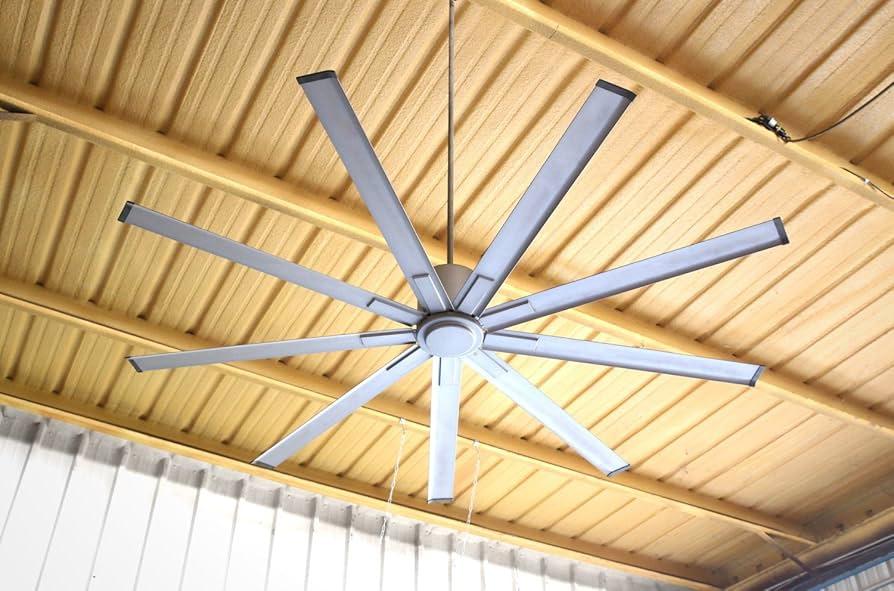
Large spaces such as warehouses, factories, gymnasiums, agricultural buildings, and commercial halls require powerful and efficient airflow solutions. Standard ceiling fans are not designed to handle these environments. Industrial ceiling fans, however, are built to move large volumes of air while maintaining energy efficiency and durability.
Choosing the right industrial ceiling fan involves understanding size, airflow capacity, installation requirements, and long-term performance. This guide will help you make the right decision.
Why Large Spaces Need Industrial Ceiling Fans
Large facilities often struggle with:
-
Poor air circulation
-
Heat stratification (warm air trapped near the ceiling)
-
Uneven temperature distribution
-
High HVAC energy costs
Industrial ceiling fans improve air movement, create consistent temperatures, and enhance overall comfort.
1. Determine the Right Fan Size
Fan diameter plays a major role in coverage and performance.
General Size Guidelines:
-
8–12 feet: Medium commercial spaces
-
14–18 feet: Large warehouses and factories
-
20–24 feet: Very large industrial facilities
The higher the ceiling, the larger the fan diameter required for effective air distribution.
2. Check Airflow Capacity (CFM)
CFM (Cubic Feet per Minute) measures how much air a fan moves. Higher CFM means greater airflow.
When comparing models, consider:
-
Total CFM output
-
CFM per watt (energy efficiency rating)
-
Recommended coverage area
Selecting the correct airflow capacity ensures proper ventilation without wasting energy.
3. Consider Ceiling Height and Mounting Requirements
Ceiling height directly impacts performance and safety.
Important factors include:
-
Minimum clearance from the floor
-
Distance from lighting and sprinklers
-
Structural support strength
-
Downrod or extension length
Proper mounting ensures optimal airflow and long-term stability.
4. Evaluate Energy Efficiency
Industrial ceiling fans should reduce energy consumption, not increase it.
Look for:
-
Energy-efficient motors
-
Variable speed controls
-
Direct-drive systems (low maintenance)
Efficient fans lower HVAC dependency by redistributing air effectively.
5. Assess Durability and Build Quality
Industrial environments can be demanding. Your fan should be built with:
-
Heavy-duty materials
-
Corrosion-resistant blades
-
Reliable motor systems
-
Long warranty coverage
Durability ensures consistent performance over years of operation.
6. Calculate Long-Term ROI
Although industrial ceiling fans require an upfront investment, the long-term benefits include:
-
Reduced heating and cooling costs
-
Improved worker comfort and productivity
-
Lower HVAC maintenance expenses
-
Better air circulation and safety
Many facilities recover costs within a few years through energy savings.
Final Thoughts
Choosing the right industrial ceiling fan for large spaces requires careful evaluation of size, airflow capacity, installation needs, and efficiency. The goal is to create balanced air circulation that enhances comfort while reducing operational costs.
With proper selection and professional installation, industrial ceiling fans can significantly improve airflow performance and deliver measurable energy savings for years to come.

 English
 Arabic
 Spanish
 Portuguese
 Deutsch
 Turkish
 Dutch
Dutch
 Italiano
 Russian
 Romaian
 Portuguese (Brazil)
 Greek
Greek