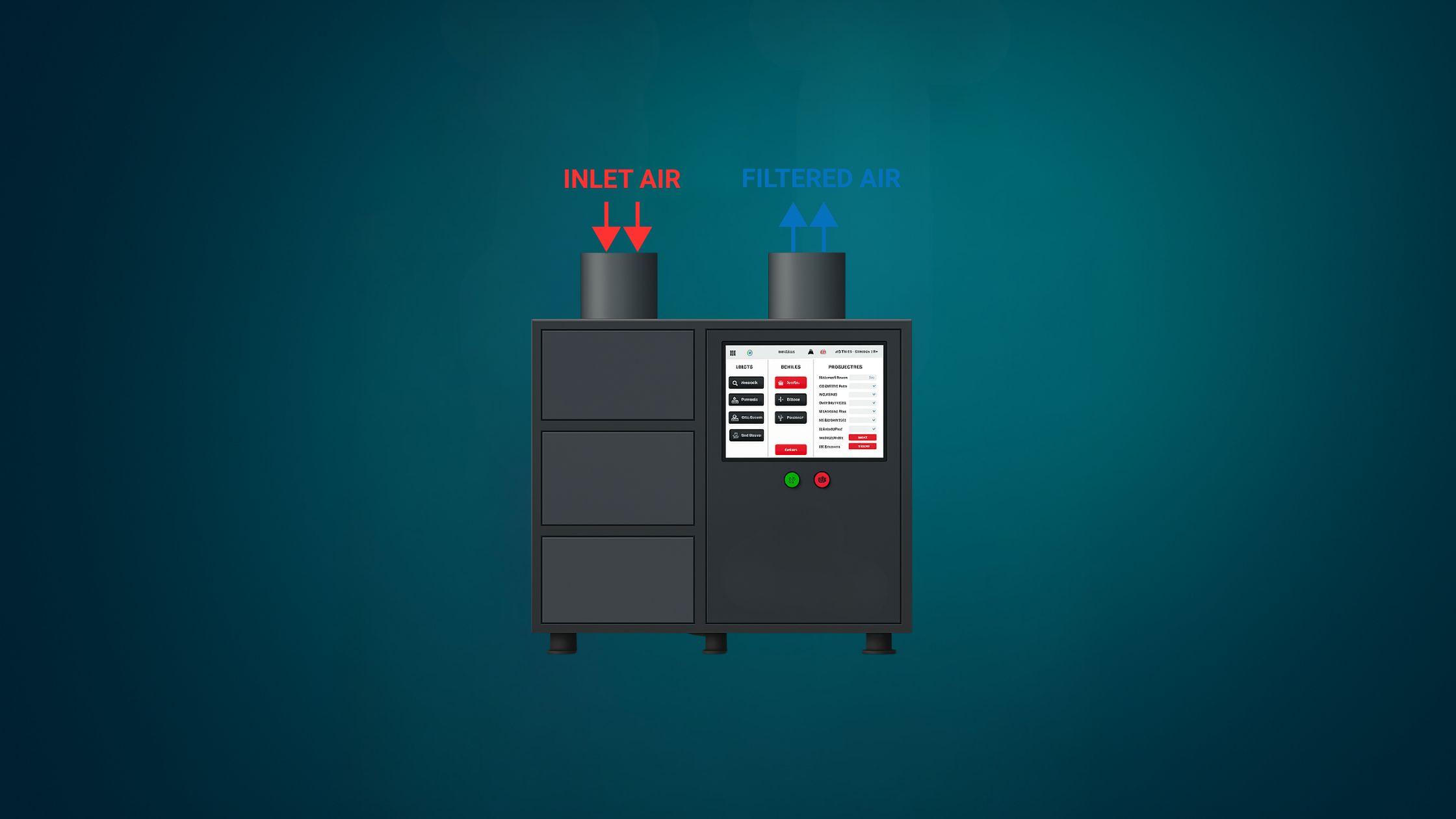
A naval shore installation seals its underground command facility for a 48-hour readiness drill. No external breach, no contamination event — just a closed-loop airtight environment running on internal life support alone.
Twenty hours in, the air feels different. Not visibly, not by smell — but the people inside are sluggish, slower to respond, harder to keep alert on watch.
This is the reality submarines have understood for decades and sealed bunkers are still catching up to: in any airtight environment, the air itself becomes the enemy long before any external threat does. A CO2 removal system isn't optional equipment in these settings — it's as fundamental as the seal on the door itself.
The Shared Problem Submarines and Bunkers Both Face
Submarines and underground bunkers seem like unrelated environments. One floats, one's buried. But they share an identical engineering constraint: a fixed volume of air, sealed against the outside world, with no fresh air exchange for extended periods.
Every occupant exhales CO2 continuously. In an open environment, this disperses harmlessly. In a sealed one, it accumulates — and accumulation is a mathematical certainty, not a possibility.
This is precisely why naval engineers solved CO2 scrubbing decades before it became a defence-engineering priority for ground-based shelters. Submarines couldn't surface for fresh air during extended patrols; bunkers can't open blast doors during an active threat. The constraint is the same.
Filtration Protects Against the Outside. Scrubbing Protects Against the Inside.
This distinction trips up a surprising number of shelter designers. NBC filtration systems are engineered to keep contaminated external air out while maintaining positive pressure.
But filtration does nothing about CO2 generated inside the sealed space by the very occupants it's protecting. That's an entirely separate engineering discipline — internal atmosphere management — and it's where a CO2 scrubber earns its place as essential infrastructure rather than supplementary equipment.
How Scrubbing Technology Solves This
Modern CO2 removal system designs rely on a few proven absorption approaches, each suited to different operational profiles.
Chemical absorption, using lithium hydroxide or soda lime, reacts directly with CO2 to form stable solid byproducts. It's dependable and well-validated, though the media is consumed and needs scheduled replacement.
Regenerative scrubbers use materials that can be cycled — thermally or through pressure changes — to release captured CO2 and be reused, which suits longer-duration or recurring sealed operations better than consumable media.
Molecular sieve systems offer a compact, energy-efficient alternative, using engineered pore structures that selectively capture CO2 molecules from circulating air.
Why Occupancy Load Determines Everything
The calculation that matters most isn't shelter size — it's occupant count multiplied by exhaled CO2 rate, measured against your scrubbing system's actual capacity.
A submarine crew or bunker occupancy that exceeds design assumptions will exhaust scrubbing capacity faster than planned, regardless of how large the sealed space is. This single number should drive every downstream equipment decision.
Oxygen Management Runs Alongside CO2 Removal
As CO2 builds, oxygen depletes — the two processes happen simultaneously. Submarines have long paired scrubbing systems with oxygen generation or supplementation, and the same principle applies to long-duration bunker occupancy.
Reliable systems monitor both gases continuously, with alarm thresholds calibrated to give operators real time to respond before levels become physiologically dangerous.
Integration With Pressurization and Filtration
A scrubbing system doesn't operate independently — it shares airspace with positive-pressure NBC filtration and recirculation systems. Poorly integrated equipment can disrupt airflow patterns that both systems depend on.
This is one of the most overlooked engineering details in CO2 scrubber for bunker installations: integration needs to be designed jointly with filtration and pressurization systems, not added afterward.
Key Features That Define Reliable Systems
Across both submarine and bunker applications, dependable scrubbing equipment shares common traits:
- Real-time CO2 monitoring with redundant sensor verification
- Absorption media matched to occupancy and mission duration
- Compatibility with existing pressurization and filtration infrastructure
- Low power draw with dependable backup power continuity
- Corrosion-resistant construction for long-term sealed readiness
- Compact, modular footprint that doesn't compete for limited interior space
- Quiet operation, critical in command and watch environments
Where This Engineering Discipline Applies Beyond Submarines
The same principles govern military bunkers, NBC-protected command centres, civil defence shelters, border security underground installations, government continuity facilities, and sealed data centre enclosures — anywhere extended airtight occupancy is a genuine operational requirement.
Selecting the Right System for Your Application
Sound selection depends on occupancy duration, shelter or vessel volume, integration requirements with existing filtration, power availability, and compliance with relevant defence air-quality standards — not on CO2 scrubber price alone.
Lifecycle reliability outweighs upfront cost in any application where a failure means occupants are breathing degraded air with nowhere to go.
Evaluating Manufacturers Before You Commit
Look for demonstrated engineering experience in life-support or defence-grade air management, documented testing and validation history, applicable compliance certifications, and real customization capability for your occupancy and integration profile.
Organizations exploring the CO2 Removal System category for bunker or strategic facility applications should also confirm available technical support and maintenance services — sealed-environment equipment that fails without accessible support undermines the entire purpose of the installation.
Mistakes That Compromise Sealed-Environment Air Safety
- Assuming filtration alone handles internal air quality
- Sizing scrubbing capacity by volume instead of occupancy-based generation
- Selecting equipment on cost without lifecycle analysis
- Neglecting backup power planning for continuous operation
- Skipping integration design with existing pressurization systems
- Failing to test and commission systems under realistic occupancy conditions
Final Word
Submarines proved decades ago that sealed environments demand dedicated internal atmosphere management — filtration alone was never enough, and bunkers face the identical constraint. A properly engineered CO2 removal system is what keeps a sealed crew or shelter occupant alert, capable, and safe for as long as the mission demands.
The lesson from naval engineering is straightforward: in any airtight space, air quality isn't a convenience — it's the foundation everything else depends on. Get the scrubbing right, and sustained habitability stops being a question mark during the moments it matters most.

 Arabic
 French
 Spanish
 Portuguese
 Deutsch
 Turkish
 Dutch
Dutch
 Italiano
 Russian
 Romaian
 Portuguese (Brazil)
 Greek
Greek