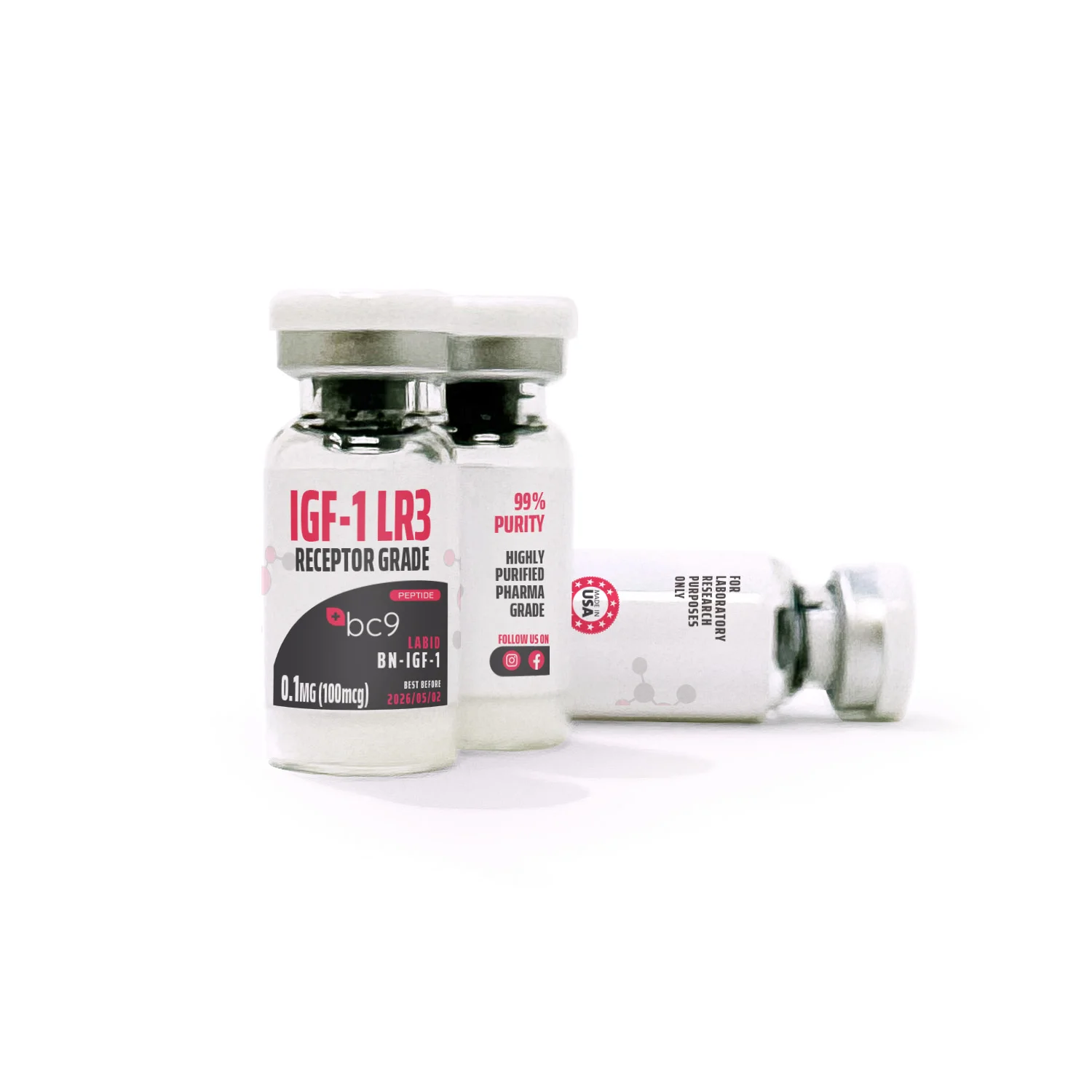
Overview of IGF-1 LR3
IGF-1 LR3 is a synthetic analog of insulin-like growth factor 1 engineered with an extended amino acid sequence and a targeted amino acid substitution. This structural refinement is designed to significantly reduce binding to IGF-binding proteins (IGFBPs), resulting in prolonged receptor availability and enhanced signaling persistence in controlled research environments. As a result, IGF-1 LR3 has become a focal compound in cellular growth, metabolic signaling, and tissue response studies.
Molecular Structure and Extended-Chain Design
The defining characteristic of IGF-1 LR3 lies in its modified peptide chain. The molecule includes:
- An N-terminal extension of additional amino acids that alters binding dynamics.
- A single amino acid substitution that reduces affinity for circulating IGFBPs.
These changes collectively increase molecular stability and extend functional presence at the cellular level. Compared to native IGF-1, IGF-1 LR3 demonstrates a longer interaction window with IGF-1 receptors (IGF-1R), making it particularly valuable for sustained signaling analysis.
IGF-1 LR3 and Receptor Binding Dynamics
IGF-1 LR3 exhibits a high affinity for the IGF-1 receptor, a transmembrane tyrosine kinase involved in growth and metabolic regulation. Reduced sequestration by IGFBPs allows a greater proportion of the molecule to remain bioavailable for receptor engagement. This characteristic enables researchers to observe prolonged downstream signaling cascades under tightly controlled experimental conditions.
Intracellular Signaling Pathways Activated by IGF-1 LR3
Upon receptor activation, IGF-1 LR3 initiates several well-characterized intracellular pathways:
- PI3K/Akt pathway, associated with cell survival and metabolic regulation.
- MAPK/ERK pathway, linked to cellular proliferation and differentiation.
- mTOR signaling, involved in protein synthesis and cellular growth regulation.
The extended activity profile of IGF-1 LR3 allows for deeper analysis of pathway duration, signal amplification, and feedback regulation compared to native IGF-1.
Comparative Stability and Bioavailability in Research Models
One of the most studied attributes of IGF-1 LR3 is its enhanced stability in vitro and in certain experimental models. The reduced interaction with IGFBPs minimizes rapid clearance and degradation, enabling longer observational windows. This makes IGF-1 LR3 particularly suitable for:
- Longitudinal cell culture experiments
- Signal persistence and desensitization studies
- Comparative receptor activation analyses
Applications in Cellular and Molecular Research
IGF-1 LR3 is widely utilized in non-clinical research settings to explore:
- Cellular growth kinetics
- Metabolic signaling regulation
- Tissue response mechanisms
- Gene expression modulation related to growth factor signaling
Its predictable interaction profile and extended activity make it a preferred analog for experiments requiring consistent and measurable receptor stimulation.
Quality Considerations for Research-Grade IGF-1 LR3
High-purity IGF-1 LR3 is essential for reproducible research outcomes. Key quality indicators include:
- Verified amino acid sequence accuracy
- High-performance liquid chromatography (HPLC) purity confirmation
- Mass spectrometry validation
- Absence of residual solvents and synthesis byproducts
Consistent quality standards ensure that observed effects are attributable to IGF-1 LR3 itself rather than confounding variables.
IGF-1 LR3 Versus Native IGF-1: Key Differences
| Attribute | IGF-1 | IGF-1 LR3 |
| IGFBP Binding | High | Significantly Reduced |
| Functional Duration | Short | Extended |
| Molecular Stability | Moderate | Enhanced |
| Research Utility | Baseline studies | Sustained signaling analysis |
These distinctions explain why IGF-1 LR3 is frequently selected for advanced mechanistic research over native IGF-1.
Research Significance of IGF-1 LR3
IGF-1 LR3 remains a critical tool in growth factor research due to its engineered persistence and reliable receptor interaction. Its molecular design allows for refined exploration of signaling duration, pathway cross-talk, and cellular adaptation mechanisms. These attributes continue to position IGF-1 LR3 as a benchmark compound in advanced biochemical and cellular research frameworks.

 Arabic
 French
 Spanish
 Portuguese
 Deutsch
 Turkish
 Dutch
Dutch
 Italiano
 Russian
 Romaian
 Portuguese (Brazil)
 Greek
Greek