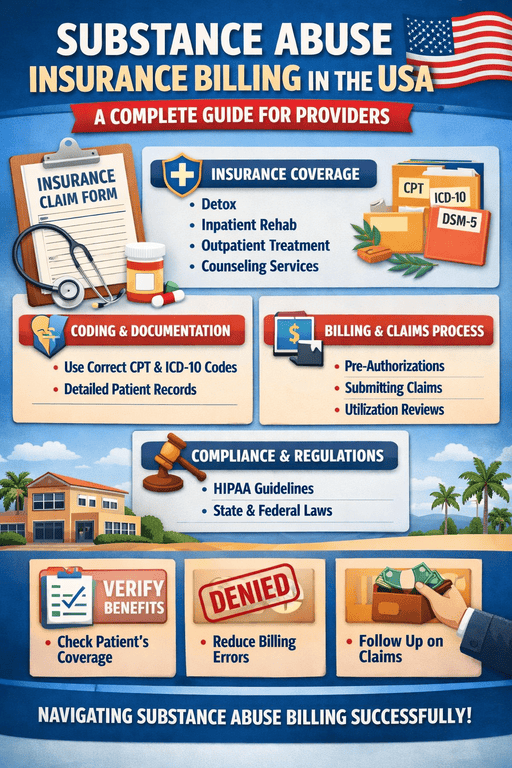
Introduction
Substance abuse treatment has become one of the most critical components of the U.S. healthcare system, especially as demand for behavioral health services continues to rise. However, behind every successful treatment program lies a complex administrative backbone—substance abuse billing and coding.
Unlike standard medical billing, billing for addiction treatment involves strict documentation rules, insurance verification challenges, evolving payer policies, and sensitive coding requirements. Even small errors can lead to claim denials, delayed reimbursements, or compliance issues.
For providers, understanding the structure of substance abuse billing, insurance requirements, and coding accuracy is not just a financial necessity—it directly impacts patient care continuity.
This article breaks down how medical billing for substance abuse works in the USA, the challenges providers face, and how specialized systems like medical billing and coding services, revenue cycle management services, and credentialing services help improve financial outcomes.
Understanding Substance Abuse Billing and Coding
Substance abuse medical billing refers to the process of translating addiction treatment services into standardized medical codes and submitting them to insurance companies for reimbursement.
This includes services such as:
- Detoxification programs
- Inpatient rehabilitation
- Outpatient counseling
- Medication-assisted treatment (MAT)
- Behavioral therapy sessions
Each service must be accurately documented and translated into CPT, ICD-10, and HCPCS codes.
On the other hand, medical coding services ensure that every diagnosis and treatment is correctly classified so that insurers understand the medical necessity of care.
Together, billing and coding form the foundation of financial operations in behavioral health facilities.
Why Substance Abuse Billing Is More Complex Than Standard Medical Billing
Unlike general healthcare billing, substance abuse treatment is tightly regulated and varies widely by insurance provider.
Some key complexities include:
1. Insurance Verification Challenges
Many patients require pre-authorization before treatment begins. Missing this step can result in denied claims.
2. Medical Necessity Documentation
Insurance companies require detailed proof that treatment is essential and not optional.
3. Varied Levels of Care
From detox to residential treatment, each level has different billing codes and reimbursement rules.
4. Sensitive Diagnosis Coding
Substance use disorders require precise ICD-10 codes that reflect severity, substance type, and patient condition.
5. Frequent Policy Changes
Payers frequently update behavioral health coverage guidelines, making compliance a moving target.
Core Components of Substance Abuse Billing Services
Effective substance abuse billing services involve multiple interconnected processes that ensure clean claim submission and faster reimbursement cycles.
Patient Intake and Insurance Verification
Before treatment begins, eligibility checks confirm coverage, co-pays, deductibles, and authorization requirements.
Accurate Documentation
Clinical documentation must support every billed service, including therapy notes and treatment plans.
Medical Coding Accuracy
Proper use of CPT and ICD-10 codes ensures claims reflect the correct level of care.
Claim Submission
Clean claims are submitted electronically to insurance payers with minimal errors.
Denial Management
Rejected claims are analyzed, corrected, and resubmitted to recover lost revenue.
Payment Posting and Reconciliation
Payments are matched against claims to ensure accuracy in revenue tracking.
Role of Substance Abuse Billing Companies in Healthcare Revenue
Many providers rely on substance abuse billing companies to manage complex billing workflows. These companies specialize in behavioral health revenue systems and understand payer-specific requirements.
A professional substance abuse billing company typically provides:
- End-to-end claim management
- Denial tracking and appeal support
- Compliance monitoring
- Coding accuracy audits
- Revenue optimization strategies
Outsourcing billing allows treatment centers to focus more on patient care rather than administrative burdens.
Insurance Billing Challenges in Substance Abuse Treatment
Substance abuse insurance billing is one of the most difficult areas of behavioral healthcare administration.
Common issues include:
- Prior authorization delays
- Coverage limitations for residential treatment
- Out-of-network reimbursement restrictions
- Medical necessity disputes
- Partial claim approvals
To overcome these challenges, providers must maintain strong documentation practices and ensure accurate coding alignment with payer policies.
Importance of Medical Billing and Coding Services in Behavioral Health
High-quality medical billing and coding services play a critical role in reducing claim denials and improving cash flow.
When billing and coding are aligned correctly, providers benefit from:
- Faster reimbursements
- Reduced administrative workload
- Improved compliance accuracy
- Lower denial rates
- Better financial forecasting
In substance abuse treatment, even minor coding errors can lead to significant revenue loss. That’s why integrated systems are essential.
Revenue Cycle Management in Substance Abuse Treatment Facilities
Revenue cycle management services (RCM) oversee the entire financial lifecycle of a patient—from appointment scheduling to final payment collection.
In substance abuse treatment centers, RCM includes:
- Pre-registration and eligibility checks
- Charge capture and coding
- Claims submission and tracking
- Payment posting
- Denial management
- Reporting and analytics
A strong RCM system ensures that no revenue is lost due to administrative inefficiencies or coding errors.
Credentialing Services and Their Role in Billing Success
Before a provider can bill insurance companies, they must be credentialed with payers.
Credentialing services ensure that:
- Providers are enrolled with insurance networks
- Credentials are verified and updated
- Re-credentialing deadlines are met
- Compliance standards are maintained
Without proper credentialing, claims are automatically rejected, regardless of clinical accuracy. This makes credentialing a foundational step in substance abuse billing operations.
Real-World Example: Why Proper Billing Matters
Consider a behavioral health clinic offering outpatient addiction treatment. Without proper billing systems in place, the clinic might:
- Miss prior authorization requirements
- Use incorrect ICD-10 codes for substance use disorders
- Submit claims without complete documentation
The result?
- Claim denials
- Delayed payments
- Revenue leakage
- Administrative overload
Now compare this with a clinic using structured billing systems supported by medical billing services and medical coding services—claims are cleaner, approvals are faster, and revenue cycles remain stable.
Best Practices for Substance Abuse Billing and Coding
To improve efficiency and reduce denials, providers should follow these best practices:
Maintain Accurate Documentation
Every therapy session, diagnosis update, and treatment plan must be clearly recorded.
Stay Updated with Insurance Policies
Behavioral health coverage rules change frequently.
Use Standardized Coding Systems
ICD-10, CPT, and HCPCS codes must be applied consistently.
Conduct Regular Billing Audits
Internal audits help identify errors before claim submission.
Train Staff Continuously
Billing and coding teams must stay updated with regulatory changes.
How Specialized Billing Partners Improve Outcomes
Partnering with experts in substance abuse billing and coding can significantly improve operational efficiency.
Experienced teams help providers:
- Reduce claim denials
- Improve reimbursement speed
- Maintain compliance with healthcare regulations
- Optimize financial performance
- Streamline administrative workflows
Organizations like 247 Medical Billing Services support healthcare providers with end-to-end solutions including medical billing services, medical coding services, medical billing and coding services, revenue cycle management services, and credentialing services, ensuring smoother financial operations without disrupting patient care.
Conclusion
Substance abuse treatment plays a vital role in addressing the growing addiction crisis in the United States, but financial sustainability depends heavily on accurate and efficient billing systems. Substance abuse billing and coding requires precision, compliance awareness, and strong administrative processes to ensure providers are reimbursed fairly for their services.
With rising insurance complexities and evolving healthcare regulations, healthcare organizations can no longer rely on manual or fragmented billing approaches. Instead, integrated systems supported by medical billing services, medical coding services, medical billing and coding services, revenue cycle management services, and credentialing services are essential for long-term success.
By adopting structured billing workflows and partnering with experienced professionals like 247 Medical Billing Services, behavioral health providers can focus more on patient recovery while ensuring financial stability and operational efficiency.
FAQs
1. What is substance abuse billing and coding?
It is the process of converting addiction treatment services into standardized medical codes and submitting them to insurance companies for reimbursement.
2. Why is substance abuse billing more complex than other medical billing?
It involves strict insurance rules, prior authorizations, detailed documentation, and varying levels of care, making it more complex than general healthcare billing.
3. What are common challenges in medical billing for substance abuse?
Common challenges include claim denials, insurance verification issues, coding errors, and medical necessity documentation requirements.
4. How do revenue cycle management services help in substance abuse billing?
They streamline the entire billing process—from patient intake to final payment—ensuring faster reimbursements and fewer errors.
5. Why are credentialing services important in behavioral health billing?
Credentialing ensures providers are enrolled with insurance companies, which is necessary for claims to be accepted and paid.
6. Can outsourcing improve substance abuse billing performance?
Yes, outsourcing to specialized billing companies improves accuracy, reduces denials, and enhances overall revenue performance.

 Arabic
 French
 Spanish
 Portuguese
 Deutsch
 Turkish
 Dutch
Dutch
 Italiano
 Russian
 Romaian
 Portuguese (Brazil)
 Greek
Greek