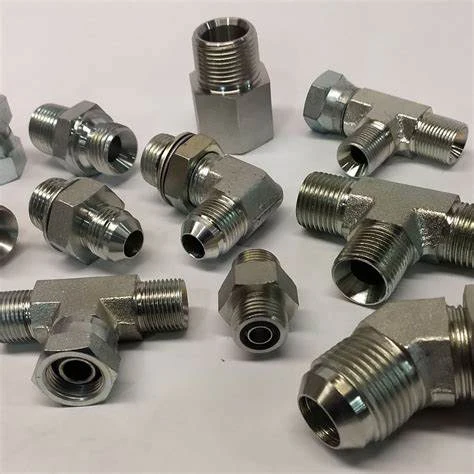
Incorrectly identifying hydraulic fitting threads is one of the most common causes of leaks, equipment failure, and costly downtime. With multiple thread standards like NPT, BSP, JIC, and ORFS, even experienced professionals can get it wrong.
In this guide, you’ll learn how to accurately identify hydraulic fitting threads using simple tools and proven methods.
At Gear House Hydraulics, we help professionals avoid mismatches by providing precision-engineered fittings and expert support.
Why Thread Identification Matters
Using the wrong thread type can lead to:
- ❌ Leaks and pressure loss
- ❌ Damaged components
- ❌ Unsafe working conditions
- ❌ Expensive repairs and downtime
Even if threads seem to “fit,” they may not seal properly.
Step-by-Step Guide to Identify Hydraulic Threads
1. Check the Thread Type (Tapered vs Parallel)
This is the first and most important step.
- Tapered Threads (NPT, BSPT):
- Threads get narrower toward the end
- Seal by thread interference
- Parallel Threads (BSPP, JIC, ORFS):
- Same diameter throughout
- Require O-ring or washer to seal
Visual inspection often gives you the first clue.
2. Measure the Thread Diameter
Use a caliper to measure the outside diameter (male) or inside diameter (female).
- Measure in inches (USA standards)
- Compare with a thread size chart
Example:
A 1/2" NPT fitting does NOT measure exactly 1/2 inch.
3. Determine Thread Pitch
Thread pitch tells you how close the threads are.
- Use a thread pitch gauge
- Or count threads per inch (TPI)
Example:
- NPT: 14 TPI (common sizes)
- BSP: Different pitch → helps identify mismatch
4. Identify the Thread Angle
Thread angle is critical for correct identification:
- NPT: 60°
- BSP: 55°
- JIC: 37° flare (not thread sealing, but important)
This is why NPT and BSP may look similar—but won’t seal.
5. Look at the Sealing Method
Different fittings seal in different ways:
- NPT: Thread sealant (PTFE tape)
- BSPP: O-ring or bonded seal
- JIC: 37° metal-to-metal flare
- ORFS: Flat face with O-ring
The sealing style often reveals the thread type instantly.
6. Use a Thread Identification Kit
For professionals, this is the most accurate method.
A typical kit includes:
- Thread gauges
- Angle gauges
- Reference charts
Ideal for workshops and industrial environments.
Common Mistakes to Avoid
❌ Mixing NPT and BSP
They may screw together—but will leak under pressure.
❌ Guessing Thread Size
Visual matching is not reliable.
❌ Ignoring Seal Type
Threads alone don’t always seal (especially BSPP).
❌ Over-Tightening Wrong Threads
Leads to permanent damage.
Quick Identification Cheat Sheet
| Fitting Type | Thread Type | Seal Method |
|---|---|---|
| NPT | Tapered | Thread sealant |
| BSPT | Tapered | Thread sealant |
| BSPP | Parallel | O-ring / washer |
| JIC | Parallel | 37° flare |
| ORFS | Parallel | O-ring face seal |
Why Choose the Right Supplier?
Correct identification is easier when you work with experts.
At Gear House Hydraulics, we offer:
- Wide range of hydraulic fittings (NPT, BSP, JIC, ORFS)
- Expert guidance to prevent mismatches
- High-quality components built for performance
Final Thoughts
Identifying hydraulic fitting threads doesn’t have to be complicated—but it does require attention to detail.
By checking thread type, diameter, pitch, angle, and sealing method, you can avoid costly mistakes and ensure a reliable connection.
For professional-grade fittings and expert support, trust Gear House Hydraulics to keep your hydraulic systems running smoothly.

 English
 Arabic
 French
 Spanish
 Portuguese
 Deutsch
 Turkish
 Dutch
Dutch
 Italiano
 Romaian
 Portuguese (Brazil)
 Greek
Greek