Introduction
Trying to conceive can feel like an emotional rollercoaster, right? One moment you're hopeful, the next you're overwhelmed with medical terms and treatment options. Among these, Hormone Replacement Therapy (HRT) often comes up—but what exactly is it, and how does it help in your fertility journey?
Think of your body like an orchestra. Hormones are the musicians, and when even one instrument is out of tune, the entire performance suffers. HRT helps bring everything back into harmony, especially when your natural hormone levels are not supporting conception.
In this guide, we’ll break down everything you need to know about HRT in simple, relatable language—so you can make informed decisions and move forward with confidence.
Learn how HRT supports fertility & IVF success. Consult the best IVF Doctor in Delhi NCR for personalized treatment.
.1 Understanding Hormones and Fertility
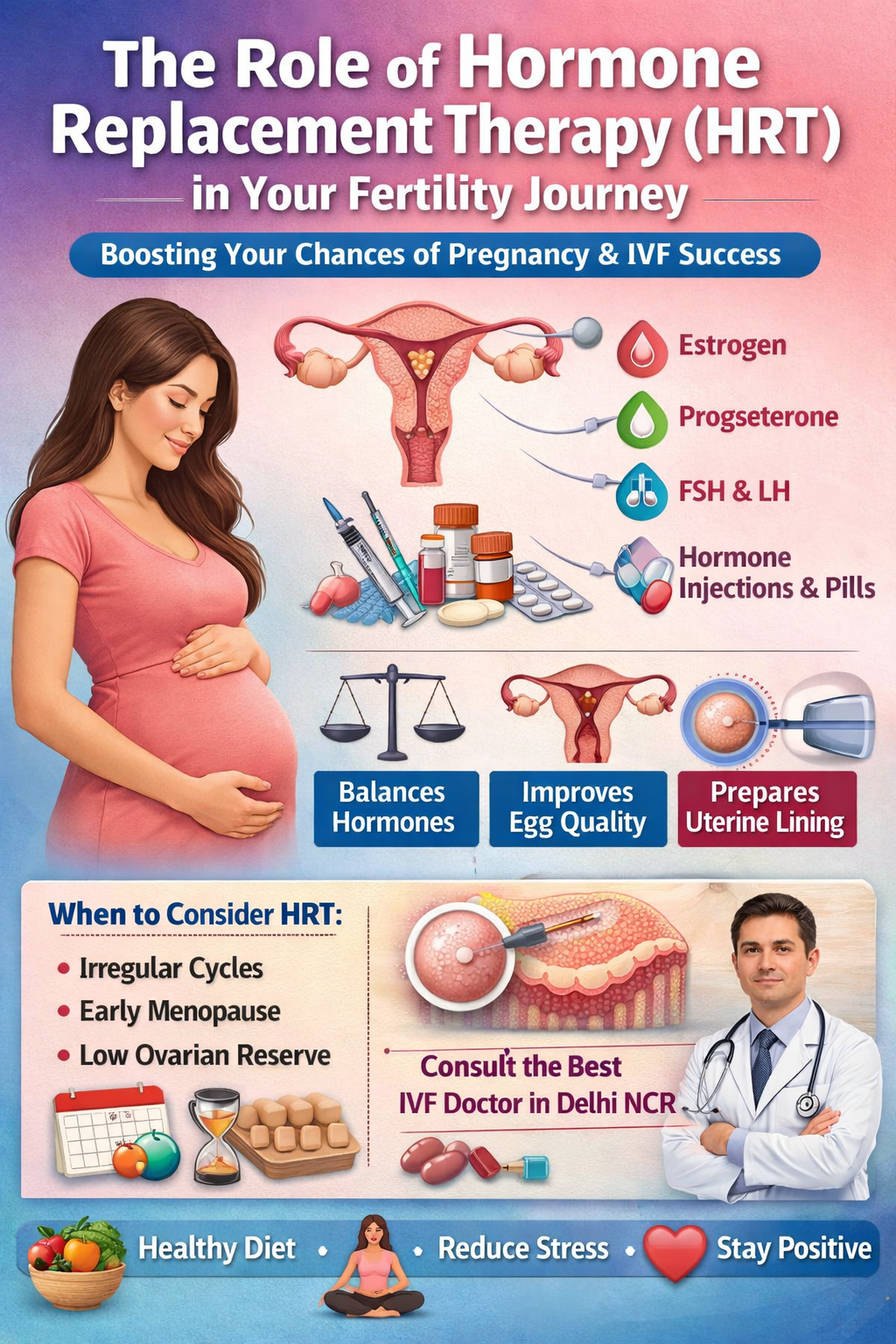
Your fertility depends heavily on hormones like estrogen, progesterone, FSH (Follicle-Stimulating Hormone), and LH (Luteinizing Hormone).
These hormones control:
- Ovulation
- Egg development
- Uterine lining preparation
If these hormones are imbalanced, conception becomes difficult. That's where HRT steps in-- to restore balance.
2. What is Hormone Replacement Therapy (HRT)?
Hormone Replacement Therapy (HRT) involves giving your body the hormones it lacks or doesn't produce in the right amounts.
It can be administered through:
- Pills
- Injections
- Patches
- Gels
The goal? To create the ideal hormonal environment for pregnancy.
3. Why Hormones Matter in Conception
Without proper hormonal balance:
- Eggs may not mature properly
- Ovulation may not occur
- The uterus may not support implantation
Think of it like planting a seed. Even if the seed (egg) is healthy, it won't grow unless the soil (uterus) is ready.
4. Who Needs HRT in Fertility Treatment?
You might need HRT if:
- You have irregular periods
- You're experiencing early menopause
- You have low ovarian reserve
- You're undergoing IVF
It's especially helpful for women whose bodies need extra hormonal support to conceive.
5. Types of Hormones Used in HRT
Estrogen
- Builds the uterine lining
- Prepares the uterus for embryo implantation
Progesterone
- Maintains pregnancy
- Supports embryo growth
FSH & LH
- Stimulate egg production
- Help ovulation
Each hormone plays a unique role, like different gears in a machine working together.
6. How HRT Works in IVF Treatment
In IVF, timing is everything. HRT helps control:
- When eggs mature
- When ovulation happens
- When the uterus is ready
Doctors use HRT to synchronize your body with the IVF process, increasing the chances of success.
7. Benefits of HRT in Fertility Journey
Why is HRT so important?
- Improves egg development
- Enhances uterine lining
- Increases implantation success
- Regulates menstrual cycles
In simple terms, HRT sets the stage for pregnancy.
8. Risks and Side Effects of HRT
Like any treatment, HRT may have side effects:
- Bloating
- Mood swings
- Headaches
- Breast tenderness
However, these are usually temporary and manageable under medical supervision.
9. HRT for Women with PCOS or Irregular Cycles
If you have PCOS (Polycystic Ovary Syndrome) or irregular cycles, your hormones may already be out of balance.
HRT helps by:
- Regulating ovulation
- Improving egg quality
- Creating predictable cycles
This makes fertility treatments more effective.
10. Role of HRT in Egg Quality and Uterine Health
Good fertility isn't just about producing eggs-- it's about producing healthy eggs and having a receptive uterus.
HRT:
- Supports egg maturation
- Improves uterine lining thickness
- Enhances implantation chances
It's like preparing both the seed and the soil for the best outcome.
11. HRT in Frozen Embryo Transfer (FET)
In FET cycles, your body may not naturally prepare for implantation.
HRT ensures:
- The uterine lining is optimal
- Timing matches embryo transfer
This significantly improves success rates.
12. Lifestyle Tips to Support HRT Success
HRT works best when combined with a healthy lifestyle:
- Eat a balanced diet
- Exercise regularly
- Reduce stress
- Avoid smoking and alcohol
Think of HRT as the engine-- and your lifestyle as the fuel that keeps it running smoothly.
13. When to Consult a Fertility Specialist
You should seek expert advice if:
- You've been trying for over a year
- You have irregular periods
- You've had failed IVF cycles
Early consultation can save time and improve outcomes.
14. Choosing the Right IVF Doctor
Your fertility journey is deeply personal, so choosing the right doctor matters.
Look for:
- Experience and success rates
- Personalized treatment plans
- Transparent communication
Consulting the best IVF Doctor in Delhi NCR can make a significant difference in your treatment success and overall experience.
15. Emotional Support During HRT Treatment
Let's be honest-- fertility treatments can be emotionally draining.
You may feel:
- Anxiety
- Hope
- Frustration
It's important to:
- Talk to your partner
- Seek counseling if needed
- Stay positive
Remember, you're not alone in this journey.
Conclusion
Hormone Replacement Therapy (HRT) plays a crucial role in modern fertility treatments. It helps balance your hormones, prepares your body for conception, and significantly improves your chances of success-- especially in IVF.
While the process may feel overwhelming at times, understanding how HRT works can empower you to make confident decisions. With the right guidance, support, and care from the best IVF Doctor in Delhi NCR, your dream of parenthood can become a reality.
FAQs
1. What is the main purpose of HRT in fertility treatment?
HRT helps balance hormones to support ovulation, egg development, and uterine preparation for pregnancy.
2. Is HRT necessary for all IVF patients?
No, HRT is recommended based on individual hormone levels and medical conditions.
3. Are there any long-term risks of HRT?
Most fertility-related HRT treatments are short-term and generally safe under medical supervision.
4. How long does HRT treatment last in IVF?
It usually lasts a few weeks to a couple of months, depending on your treatment plan.
5. Can lifestyle changes improve HRT effectiveness?
Yes, a healthy lifestyle can enhance the effectiveness of HRT and improve fertility outcomes.

 Arabic
 French
 Spanish
 Portuguese
 Deutsch
 Turkish
 Dutch
Dutch
 Italiano
 Russian
 Romaian
 Portuguese (Brazil)
 Greek
Greek